

Running a small business means wearing multiple hats every day. From managing customer inquiries and handling invoices to scheduling appointments and updating customer records, business owners often spend more time on repetitive tasks than on growing their business. These manual processes not only consume valuable time but also increase the chances of human error, delayed responses, and missed opportunities.
This is where AI workflow automation becomes a game changer. Instead of completing routine tasks manually, businesses can use artificial intelligence to automate everyday operations, allowing employees to focus on strategic work that drives growth. Whether it’s responding to customer inquiries, managing leads, processing invoices, or scheduling appointments, AI can perform these tasks faster, more accurately, and with minimal human intervention.Businesses that invest in AI Workflow Automation for Small Businesses are better positioned to improve efficiency, reduce costs, and scale their operations. Choosing the right AI Workflow Automation for Small Businesses strategy ensures long-term growth while helping teams work smarter and deliver better customer experiences.
In recent years, AI workflow automation has become accessible to businesses of all sizes. Thanks to cloud-based platforms and affordable automation tools, small businesses no longer need enterprise-level budgets to implement intelligent workflows. Companies across the UK and the USA are already using AI to streamline operations, improve customer service, and increase productivity.
This guide explains everything you need to know about AI workflow automation for small businesses, including how it works, its benefits, practical applications, implementation strategies, and how to choose the right automation solution for your business.
What Is AI Workflow Automation for Small Businesses?
AI workflow automation is the process of using artificial intelligence to automate repetitive business tasks and improve operational efficiency. Unlike traditional automation, which follows fixed rules, AI-powered systems can analyze data, understand context, recognize patterns, and make intelligent decisions. This makes AI automation more flexible and capable of handling complex business processes.
For example, imagine a customer fills out a contact form on your website. Instead of someone manually checking the inquiry, adding the customer to a CRM, assigning the lead to a salesperson, and sending a follow-up email, AI can complete all of these tasks automatically within seconds. It can even prioritize leads based on customer intent and notify the appropriate team member immediately.
Another common example is customer support. AI-powered chatbots can answer frequently asked questions, provide order updates, schedule appointments, and transfer complex cases to human agents when necessary. This reduces response times while ensuring customers receive assistance around the clock.
AI workflow automation is not about replacing employees. Instead, it helps businesses eliminate repetitive work so teams can focus on solving problems, improving customer relationships, and developing new opportunities. As businesses continue to adopt digital technologies, AI automation has become an essential tool for improving efficiency and remaining competitive.
AI Workflow Automation for Small Businesses is transforming the way companies handle repetitive tasks, improve productivity, and reduce operational costs. Instead of relying on manual processes, businesses can automate customer support, invoicing, data entry, lead management, and internal workflows using AI-powered solutions. By implementing AI Workflow Automation for Small Businesses, organizations can save valuable time, minimize human errors, and allow their teams to focus on strategic growth, innovation, and delivering a better customer experience.
Why Small Businesses Should Invest in AI Workflow Automation
Small businesses often operate with limited resources, making efficiency one of their biggest competitive advantages. Every hour spent on repetitive administrative work is an hour that cannot be invested in acquiring new customers, improving products, or expanding services.
AI workflow automation helps businesses reclaim this lost time by automating routine processes that would otherwise require manual effort. Instead of spending hours sending follow-up emails or updating spreadsheets, employees can focus on higher-value activities that contribute directly to business growth.
Automation also improves consistency across business operations. Manual processes often lead to delays, missed deadlines, duplicate records, and communication errors. AI systems perform repetitive tasks the same way every time, reducing mistakes and improving overall reliability.
Customer expectations have also changed significantly. People expect quick responses, accurate information, and seamless experiences across multiple channels. AI automation enables businesses to meet these expectations by providing instant responses, automating appointment scheduling, tracking customer interactions, and ensuring no inquiry goes unanswered.
For growing businesses, automation also makes scaling easier. As customer demand increases, automated workflows can handle higher workloads without requiring businesses to immediately hire additional administrative staff. This allows companies to grow more efficiently while maintaining excellent customer service.
Today, AI Workflow Automation for Small Businesses is no longer a luxury but a necessity for companies that want to stay competitive. Whether you run a startup, an eCommerce store, or a service-based business, AI Workflow Automation for Small Businesses can automate repetitive tasks, improve decision-making, and enhance customer satisfaction. As AI technology continues to evolve in 2026, investing in AI Workflow Automation for Small Businesses gives businesses a smarter, faster, and more scalable way to grow while reducing manual effort and operational costs.
How AI Workflow Automation for Small Businesses Works
AI workflow automation connects different business systems and allows them to work together automatically. Instead of employees manually moving information between applications, AI handles these repetitive tasks in the background.
A typical workflow begins when a customer submits a form, sends an email, or places an order. AI immediately analyzes the information, identifies the customer’s intent, and performs a series of automated actions based on predefined business rules. It can create CRM records, assign tasks to team members, send confirmation emails, schedule follow-up reminders, generate invoices, and notify managers without requiring manual input.
For example, a law firm receiving a new consultation request can automatically collect client information, schedule an appointment, create a client record, and send confirmation emails within minutes. Similarly, a healthcare clinic can automate patient registrations, appointment reminders, billing notifications, and follow-up communications, reducing administrative workload while improving patient satisfaction.
The real strength of AI workflow automation lies in its ability to connect multiple systems into one intelligent process. Customer relationship management software, accounting platforms, marketing tools, communication applications, and project management systems can all work together seamlessly, creating faster and more efficient business operations.
Benefits of AI Workflow Automation for Small Businesses
One of the biggest reasons businesses invest in AI workflow automation is the amount of time it saves. Employees often spend hours every week replying to emails, updating customer records, preparing invoices, assigning tasks, and following up with clients. Although these tasks are necessary, they don’t directly contribute to business growth. Automating them allows teams to focus on activities that generate revenue and improve customer relationships.
Another major advantage is cost reduction. Hiring additional staff to manage repetitive administrative work can quickly increase operating expenses. AI automation reduces the need for manual intervention, allowing businesses to handle more work without significantly increasing payroll costs. This makes automation especially valuable for startups and small businesses that need to grow while controlling expenses.
Customer experience also improves significantly when AI handles routine interactions. Customers appreciate quick responses, timely updates, and accurate information. AI can instantly acknowledge inquiries, answer common questions, send appointment reminders, and keep customers informed throughout their journey. Faster communication builds trust and increases customer satisfaction.
Accuracy is another important benefit. Manual data entry often leads to duplicate records, missing information, or incorrect customer details. Automated workflows follow predefined processes consistently, reducing human errors and ensuring business data remains organized and reliable.
Perhaps the greatest benefit is scalability. As a business grows, the number of inquiries, orders, and administrative tasks also increases. AI workflow automation enables businesses to manage this increased workload without sacrificing service quality or overloading employees.
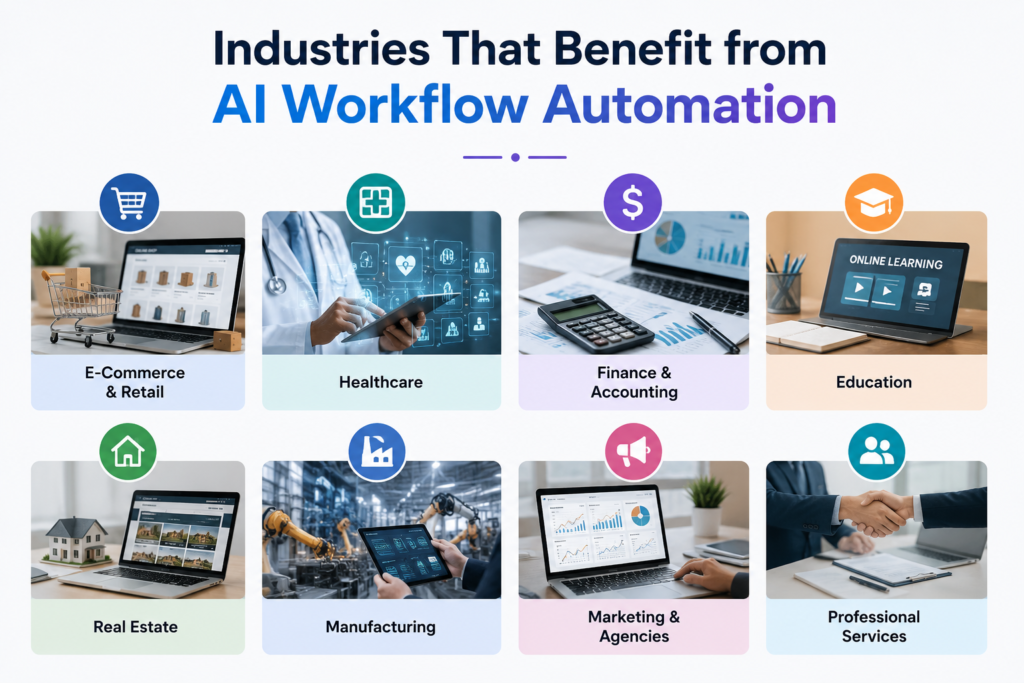
Industries That Benefit from AI Workflow Automation
AI workflow automation can be applied across almost every industry, but some sectors benefit more because they rely heavily on repetitive administrative work. Healthcare providers use automation to schedule appointments, send reminders, manage patient records, and streamline billing. This reduces administrative pressure while improving the patient experience.
Law firms automate client intake, appointment scheduling, document management, and follow-up communication. Rather than spending hours organizing paperwork and responding to routine inquiries, legal professionals can focus on serving their clients more effectively.
Accounting firms also benefit from AI automation by simplifying invoice generation, payment reminders, expense tracking, and financial reporting. During busy periods such as tax season, automated workflows help accountants manage larger workloads with greater accuracy.
Logistics companies use AI to monitor shipments, update customers about delivery status, optimize routes, and generate operational reports. These improvements lead to faster communication and better supply chain management.
Real estate agencies automate lead qualification, property inquiries, viewing appointments, and follow-up campaigns. By reducing manual administrative work, agents can spend more time building relationships with buyers and sellers.
E-commerce businesses also benefit from automation by managing inventory updates, processing orders, sending shipping notifications, handling customer support, and recovering abandoned carts. These automated processes improve operational efficiency while enhancing the customer shopping experience.
Common Business Processes You Can Automate
Every business has repetitive tasks that consume valuable time. AI workflow automation helps eliminate these manual activities by connecting different business systems into a single intelligent workflow.
Customer support is one of the most common areas for automation. AI-powered assistants can answer frequently asked questions, provide order updates, create support tickets, and route complex issues to the appropriate team member. Customers receive faster responses while support teams spend more time solving complex problems.
Lead management is another process that benefits from automation. When a visitor submits a contact form, AI can automatically create a CRM record, assign the lead to the correct salesperson, send a welcome email, and schedule future follow-ups. This ensures that every potential customer receives timely attention without requiring manual input.
Businesses can also automate appointment scheduling, invoice generation, payment reminders, employee onboarding, marketing campaigns, document approvals, project management, and internal reporting. By integrating these processes into a single workflow, organizations reduce delays, improve collaboration, and create a more efficient working environment.
Choosing the Right AI Workflow Automation Solution
Selecting the right automation platform depends on your business goals, existing software, and future growth plans. Before investing in any solution, identify the repetitive tasks that consume the most time and determine which processes would provide the highest return if automated.
Look for platforms that integrate with your current CRM, accounting software, email systems, and project management tools. Easy integration reduces implementation time and ensures that data flows smoothly between applications.
Scalability is another important consideration. Your automation solution should support future business growth without requiring a complete rebuild. As your customer base expands, the platform should be capable of handling additional workflows and larger volumes of data.
Security should never be overlooked. Choose providers that offer strong data protection, access controls, regular security updates, and compliance with industry standards. Protecting customer information is essential for maintaining trust and meeting regulatory requirements.
Finally, work with an experienced AI automation partner who understands your industry and business objectives. A knowledgeable implementation team can design customized workflows, provide technical support, and help your business maximize the value of automation.
Frequently Asked Questions
What is AI workflow automation?
AI workflow automation uses artificial intelligence to automate repetitive business processes, helping organizations improve efficiency, reduce manual work, and increase productivity.
Is AI workflow automation suitable for small businesses?
Yes. Modern automation platforms are affordable and scalable, making them suitable for startups and small businesses as well as large enterprises.
Which business processes can be automated?
Businesses commonly automate customer support, CRM updates, appointment scheduling, invoicing, lead management, employee onboarding, reporting, email marketing, and document approvals.
How long does implementation take?
Implementation depends on the complexity of your workflows and software integrations. Simple automation projects can be completed relatively quickly, while larger implementations require additional planning and testing.
Will AI replace employees?
No. AI is designed to automate repetitive tasks rather than replace skilled professionals. It allows employees to focus on strategic work, creativity, and customer relationships instead of routine administrative duties.
Leading technology companies and research organizations continue to highlight the growing impact of AI automation on modern businesses. OpenAI is driving innovation with advanced generative AI models, while Microsoft AI is helping organizations integrate intelligent automation across Microsoft 365 and Azure. Google Cloud AI provides scalable machine learning and automation solutions for businesses of all sizes, and IBM AI focuses on enterprise-grade AI systems that improve operational efficiency. Industry research from Gartner and McKinsey & Company consistently shows that businesses adopting AI-powered workflow automation achieve higher productivity, lower operational costs, and stronger long-term growth compared to organizations that rely on manual processes.
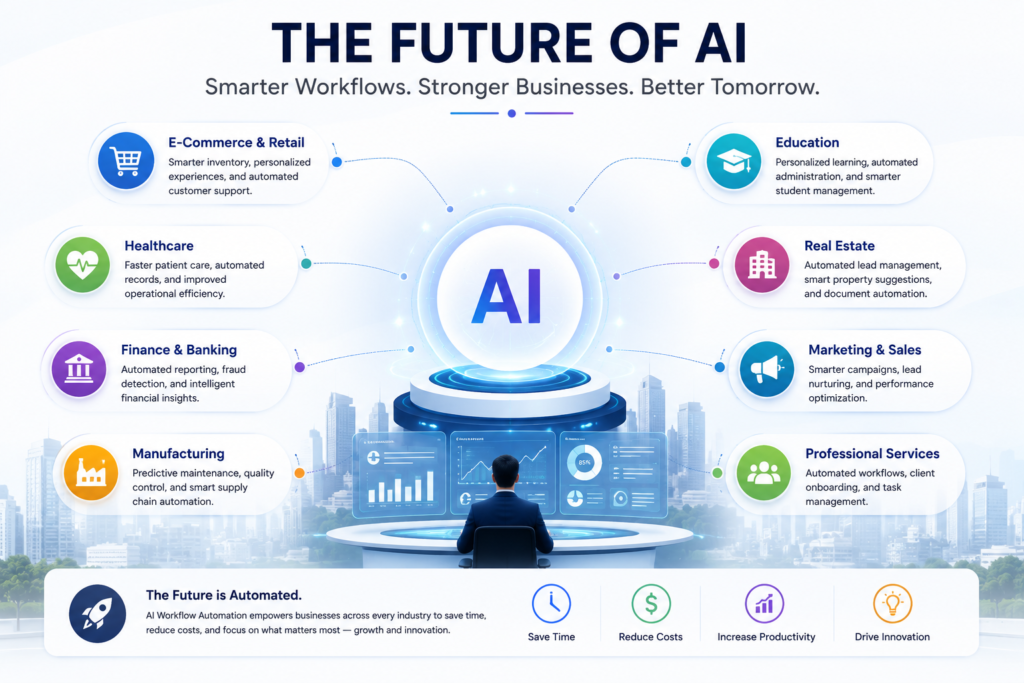
Final Thoughts
As businesses continue to embrace digital transformation, AI Workflow Automation for Small Businesses is becoming a key driver of efficiency and long-term growth. From automating customer support and sales processes to simplifying invoicing and project management, AI Workflow Automation for Small Businesses helps organizations save time, reduce operational costs, and improve overall productivity. Companies that invest in AI Workflow Automation for Small Businesses today are better prepared to scale their operations, deliver exceptional customer experiences, and stay competitive in an increasingly AI-driven business environment.
AI workflow automation has become one of the most valuable technologies for modern businesses. It enables organizations to streamline repetitive processes, improve productivity, reduce operational costs, and deliver faster customer service. Instead of spending valuable time on manual administrative work, businesses can focus on innovation, growth, and building stronger relationships with their customers.
The key to successful automation is starting with the right processes and implementing solutions that align with your business goals. As technology continues to evolve, businesses that embrace AI workflow automation today will be better positioned to compete, scale efficiently, and meet rising customer expectations.
Whether you run a healthcare clinic, law firm, accounting practice, logistics company, real estate agency, or eCommerce business, AI workflow automation can transform the way you work. By investing in intelligent automation now, you create a stronger foundation for long-term success and sustainable business growth.