Businesses often invest in off-the-shelf software because it offers a fast and affordable way to manage daily operations. Ready-made solutions are easy to deploy, require minimal setup, and usually include standard features suitable for startups and small businesses. Whether it’s accounting software, inventory management, CRM platforms, or project management tools, these applications help organizations get started without a significant upfront investment.
As businesses expand, however, their requirements become more specialized. Teams grow, customer expectations evolve, and workflows become increasingly complex. Software that once simplified operations may begin creating bottlenecks instead. Employees spend more time finding workarounds, managing disconnected systems, and handling repetitive manual tasks rather than focusing on strategic work.
One of the biggest challenges with off-the-shelf software is that it is designed to serve thousands of businesses rather than your specific organization. Every company operates differently, making it difficult for standardized software to support unique business processes. As a result, productivity decreases while operational costs continue to rise.
Growing companies eventually reach a stage where technology should accelerate business growth rather than restrict it. Investing in Custom Software Development allows businesses to build solutions tailored to their workflows, automate repetitive tasks, and improve operational efficiency without relying on unnecessary features or expensive third-party extensions.
Why Businesses Choose Off-the-Shelf Software
There is a reason why off-the-shelf solutions remain popular. They provide businesses with an affordable entry point into digital operations. Organizations can implement these systems within days or weeks instead of waiting months for custom development. Regular vendor updates, technical support, and subscription based pricing also make these platforms attractive for companies with limited budgets. Many organizations don’t realize they have outgrown off-the-shelf software until daily operations become increasingly inefficient.
For businesses in their early stages, these advantages often outweigh the limitations. Standard software usually covers common business requirements, allowing companies to manage sales, customer relationships, finance, and inventory without significant technical expertise.
However, success brings change. Business processes become more sophisticated, departments expand, and customers expect better digital experiences. Companies frequently discover they are paying for dozens of features they never use while lacking the functionality they need most. This imbalance creates inefficiencies that affect productivity, customer satisfaction, and long-term profitability.
Instead of continuing to adjust business processes around software limitations, many organizations begin exploring custom software development to create scalable solutions that align with their operational goals and future expansion plans.
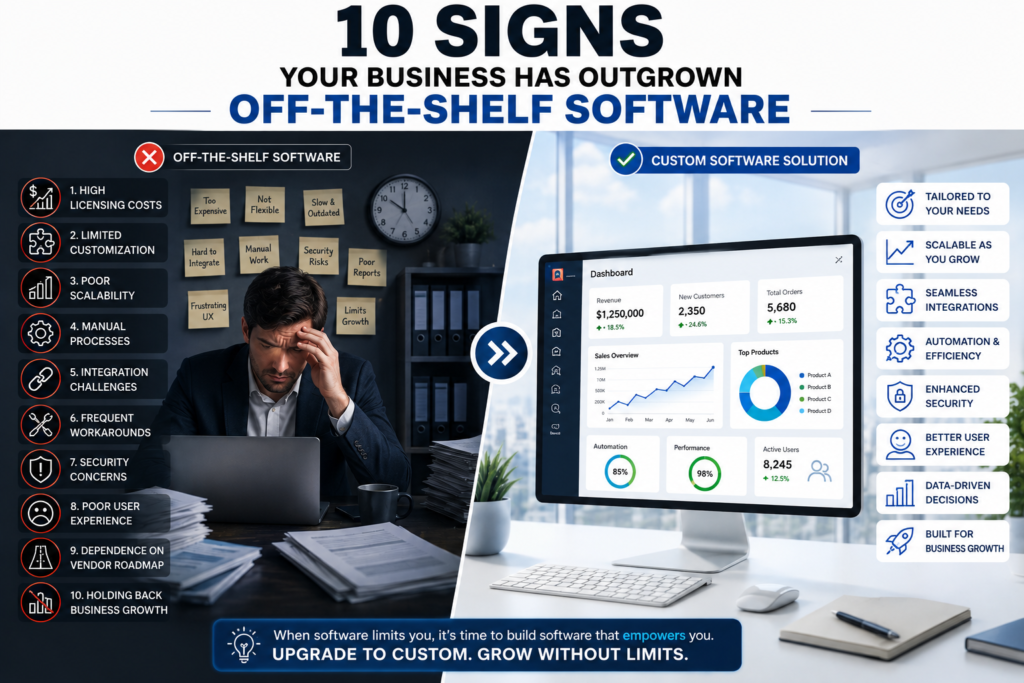
10 Signs Your Business Has Outgrown Off-the-Shelf Software
Every successful business evolves over time, but not every software platform evolves with it. If your organization experiences several of the following signs, it may be time to reconsider whether your current software is still supporting your long-term objectives.
Your Team Relies on Manual Workarounds
When employees frequently export spreadsheets, copy information between multiple systems, or repeat the same tasks every day, productivity begins to decline. Manual processes not only consume valuable time but also increase the likelihood of human error.
Instead of allowing employees to focus on innovation and customer service, outdated software forces them to spend hours performing repetitive administrative work. Businesses that eliminate these manual processes often experience significant improvements in operational efficiency and employee satisfaction.
Your Software Cannot Scale With Business Growth
Business growth should be exciting not stressful. Unfortunately, many organizations discover that their software struggles to handle increasing numbers of customers, employees, transactions, or products.
Performance issues, slow response times, and limited user capacity often indicate that the existing platform has reached its limits. Modern businesses require flexible technology that continues supporting expansion without sacrificing speed or reliability.
Integration With Other Systems Is Becoming Difficult
Today’s businesses depend on multiple digital tools working together. Customer relationship management platforms, accounting software, inventory systems, marketing automation, payment gateways, and customer support applications all need to exchange information efficiently.
When these systems cannot communicate properly, teams spend unnecessary time transferring information manually. This lack of integration reduces productivity while increasing operational complexity.
Many organizations addressing these challenges also begin planning Legacy Software Modernization initiatives to replace disconnected applications with integrated business solutions that improve collaboration and data accuracy.
Security Risks Continue to Increase
Cybersecurity threats continue evolving every year, making outdated software a growing business risk. Older applications often lack modern security updates, encryption standards, and compliance capabilities required to protect sensitive customer and company information.
Data breaches, ransomware attacks, and compliance violations can result in financial losses as well as long-term damage to customer trust. According to Microsoft Azure Application Modernization, organizations that modernize legacy applications can improve security, strengthen resilience, and reduce technical debt while preparing for future business growth.
Licensing and Subscription Costs Keep Increasing
At first, subscription-based pricing appears affordable. However, as businesses expand, recurring monthly or annual fees often increase significantly. Additional user licenses, premium features, third-party integrations, and advanced reporting modules all add to the total cost of ownership.
Many organizations eventually realize they are paying for features they never use while still lacking the capabilities they actually need. Instead of continually investing in upgrades that offer little value, businesses often shift toward Custom Web Development, allowing them to own software designed specifically for their operational requirements without unnecessary recurring expenses.
Customizations Are Becoming Expensive and Complex
Most off-the-shelf software allows only limited customization. When businesses require new workflows, advanced reporting, or industry-specific features, they often depend on plugins, external consultants, or complicated integrations.
Over time, these modifications create technical complexity that makes the software more difficult to maintain. Updates can break existing customizations, forcing businesses to spend additional time and money on fixes.
Rather than continually adapting generic software, many growing organizations choose solutions designed around their existing business processes from the beginning.
Reporting and Analytics Are No Longer Enough
Business decisions depend on reliable data. If employees need to combine spreadsheets from multiple systems before generating reports, valuable time is lost and mistakes become more common.
Modern organizations require real-time dashboards that provide clear visibility into sales, customer behavior, inventory, financial performance, and operational efficiency. Without accurate reporting, leadership teams struggle to identify opportunities, measure performance, or respond quickly to changing market conditions.
Customer Experience Is Beginning to Suffer
Customer expectations continue rising every year. Buyers expect faster response times, personalized communication, seamless online experiences, and consistent support across every channel.
When software delays order processing, prevents employees from accessing customer information, or creates unnecessary service delays, customer satisfaction naturally declines.
Businesses investing in digital transformation frequently follow recommendations from Google Cloud Application Modernization, which emphasizes building cloud-native applications that improve flexibility, performance, and customer experiences while supporting long-term innovation.
Your Business Processes Have Changed
Successful businesses rarely operate the same way they did when they first launched. New departments, additional services, expanded product lines, remote teams, and changing customer demands all require software capable of adapting alongside business growth.
Unfortunately, off-the-shelf software usually follows fixed workflows. Employees often hear statements such as:
- “The software doesn’t support this.”
- “We’ll have to do this manually.”
- “There’s no option for that.”
When software begins dictating how employees work instead of supporting business objectives, it becomes a limitation rather than a business asset.
Technology Is Limiting Future Growth
One of the clearest warning signs appears when business leaders begin making decisions based on software limitations rather than market opportunities.Companies that have outgrown off-the-shelf software usually struggle to scale without investing in modern business applications.
Perhaps the company delays launching new services because existing systems cannot support them. Maybe expansion into new markets becomes difficult because the software lacks multilingual support or advanced automation. In other cases, businesses postpone digital transformation initiatives because integrating modern technologies seems impossible.
Technology should create opportunities not prevent them.
Organizations experiencing several of these challenges often discover that investing in software built specifically for their business delivers better long-term value than continually upgrading systems that were never designed for their unique requirements.
Why Custom Software Is a Better Long-Term Investment
Custom software is built around your business instead of forcing your business to adapt to the software. Every feature, workflow, dashboard, and integration is designed to support your operational objectives.
Unlike generic applications, custom solutions eliminate unnecessary functionality while providing the exact capabilities your teams need every day. This improves efficiency, reduces manual work, and creates a better experience for both employees and customers.
Businesses investing in tailored software also gain greater flexibility as they grow. New features, additional users, integrations, and automation can be added without replacing the entire platform. This makes custom software a strategic investment rather than an ongoing operational expense.
Companies that modernize their technology strategy often achieve faster innovation, improved productivity, stronger security, and better long-term returns. According to IBM Application Modernization, modern application architectures help organizations reduce technical debt while creating scalable digital platforms capable of supporting future business growth.
The Business Benefits of Choosing Custom Software
Choosing custom software is about more than replacing an existing system. It is about creating technology that grows alongside your business and supports long-term success. Unlike generic applications, custom solutions are built specifically around your workflows, customer requirements, and business objectives.
Organizations that invest in tailored software often experience improved productivity because employees no longer need to rely on manual workarounds or disconnected systems. Business processes become faster, data flows more accurately between departments, and decision-makers gain access to real-time information that supports strategic planning.Replacing systems after you’ve outgrown off-the-shelf software allows businesses to improve productivity and support future growth
Custom software also improves flexibility. As your company expands, new features, integrations, and automation can be introduced without replacing the entire platform. This reduces future development costs while ensuring technology continues supporting business growth.
Companies looking to create scalable digital platforms frequently invest in Mobile App Development alongside custom software to deliver seamless experiences across both desktop and mobile devices.
How to Decide Whether It’s Time to Upgrade
Every business reaches a different stage of digital maturity, so there is no universal timeline for replacing off-the-shelf software. However, if operational inefficiencies continue increasing despite software updates and additional integrations, it may be time to evaluate a long-term technology strategy.
Business leaders should ask themselves several important questions:
- Are employees spending too much time on repetitive manual work?
- Are software subscription costs increasing every year?
- Does the current platform integrate with all business systems?
- Can the software support future expansion?
- Is customer experience improving or declining?
- Are reporting and analytics providing accurate business insights?
- Does the software meet current security and compliance requirements?
If the answer to several of these questions is “No,” continuing to invest in the same platform may cost more than transitioning to a custom solution.
Businesses planning long-term digital transformation often improve software usability by combining custom applications with professional UI/UX Design, creating intuitive user experiences that increase productivity and customer satisfaction.
Successful modernization projects also follow proven industry best practices. AWS Application Modernization recommends adopting phased migration strategies that reduce operational risk while improving application performance and long-term scalability.
Why Businesses Choose 3BTech
At 3BTech, we believe technology should simplify business operations rather than create unnecessary complexity. Our team works closely with organizations to understand their workflows, operational challenges, and future goals before developing software solutions tailored to their specific requirements.
From enterprise business applications and workflow automation to customer portals and cloud-ready platforms, every solution is designed with scalability, security, and long-term performance in mind. Rather than forcing businesses to adapt to generic software, we build technology that adapts to the way they already work.
Whether you’re replacing outdated applications or planning your next digital transformation initiative, our experts help businesses reduce operational costs, improve efficiency, and create software that supports sustainable growth. If your company has outgrown off-the-shelf software, investing in custom software can provide the flexibility needed to stay competitive.
Final Thoughts
Off-the-shelf software provides an excellent starting point for many businesses, but it is rarely the ideal long-term solution. As organizations grow, operational requirements become more complex, customer expectations continue evolving, and technology must keep pace with those changes.
Recognizing the warning signs early allows businesses to make strategic decisions before software limitations begin affecting productivity, customer satisfaction, and profitability. Investing in software built specifically around your business processes creates greater flexibility, stronger security, improved efficiency, and a better foundation for future innovation.
If your business is experiencing several of these challenges, now may be the right time to explore a solution designed around your unique goals instead of continuing to adapt to software that no longer supports your growth.
Ready to move beyond the limitations of off-the-shelf software? Our team at 3BTech specializes in building secure, scalable, and future-ready software solutions that help businesses grow with confidence. Contact us today to discuss your project and discover how custom software can transform your business.
The Hidden Cost of Legacy Software: Why Businesses Are Modernizing in 2026
10 Powerful Reasons UK Businesses Are Replacing Multiple Tools with One Integrated Business Platform
Looking for a Shopify Development Agency in the UK? Here’s What to Look For in 2026