Choosing the right software can have a major impact on how efficiently your business operates. The challenge is that businesses today have more options than ever. You can subscribe to a ready-made SaaS platform within minutes, or invest in custom software development designed specifically around your business.
Both approaches have clear advantages. SaaS can provide a fast and cost-effective way to access established features, while custom software can offer greater flexibility, control, and scalability.
So, custom software development vs SaaS which option makes more sense for your business in 2026?
The answer depends on your processes, budget, growth plans, technical requirements, and how much control you need over your software.
What Is Custom Software Development?
Custom software development involves designing and building software specifically for a particular business, industry, workflow, or customer requirement.
Instead of adapting your business processes to an existing platform, the software is developed around the way your organisation operates.
A custom solution could be a business management platform, customer portal, internal application, ecommerce system, SaaS product, mobile application, or a combination of multiple systems.
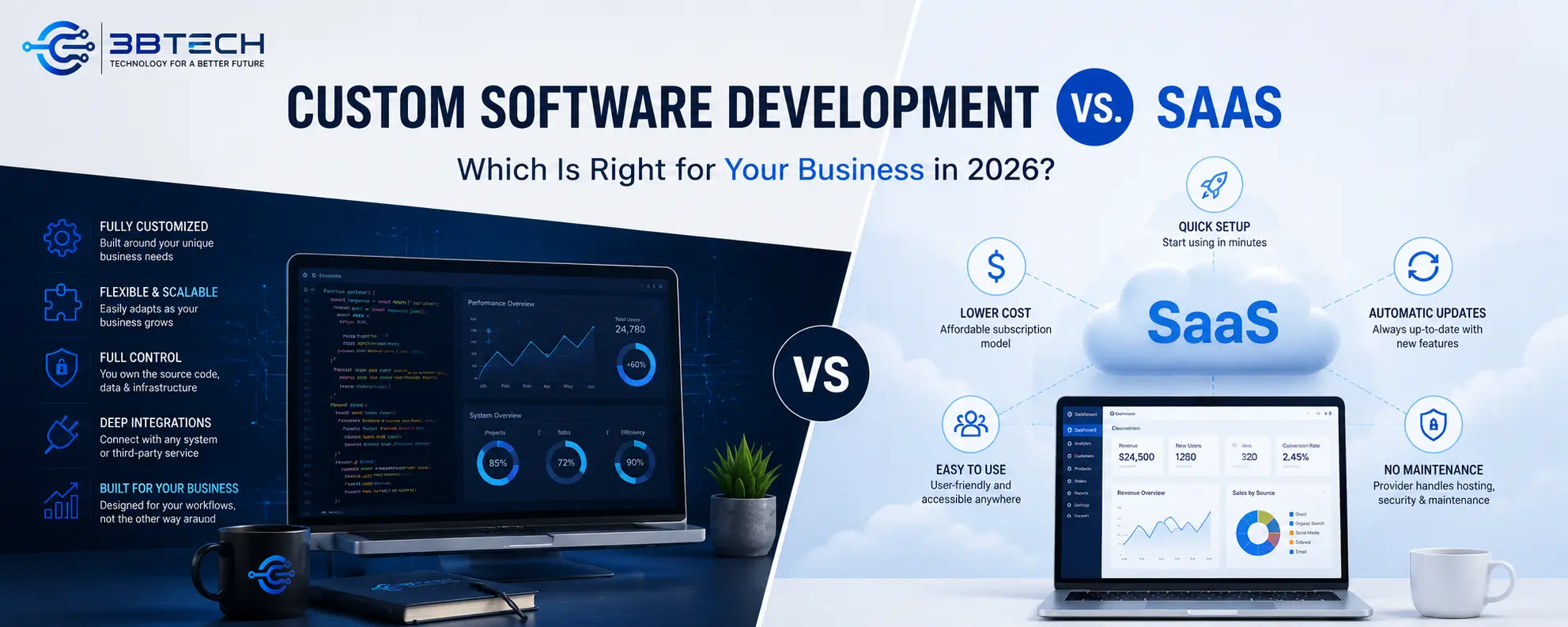
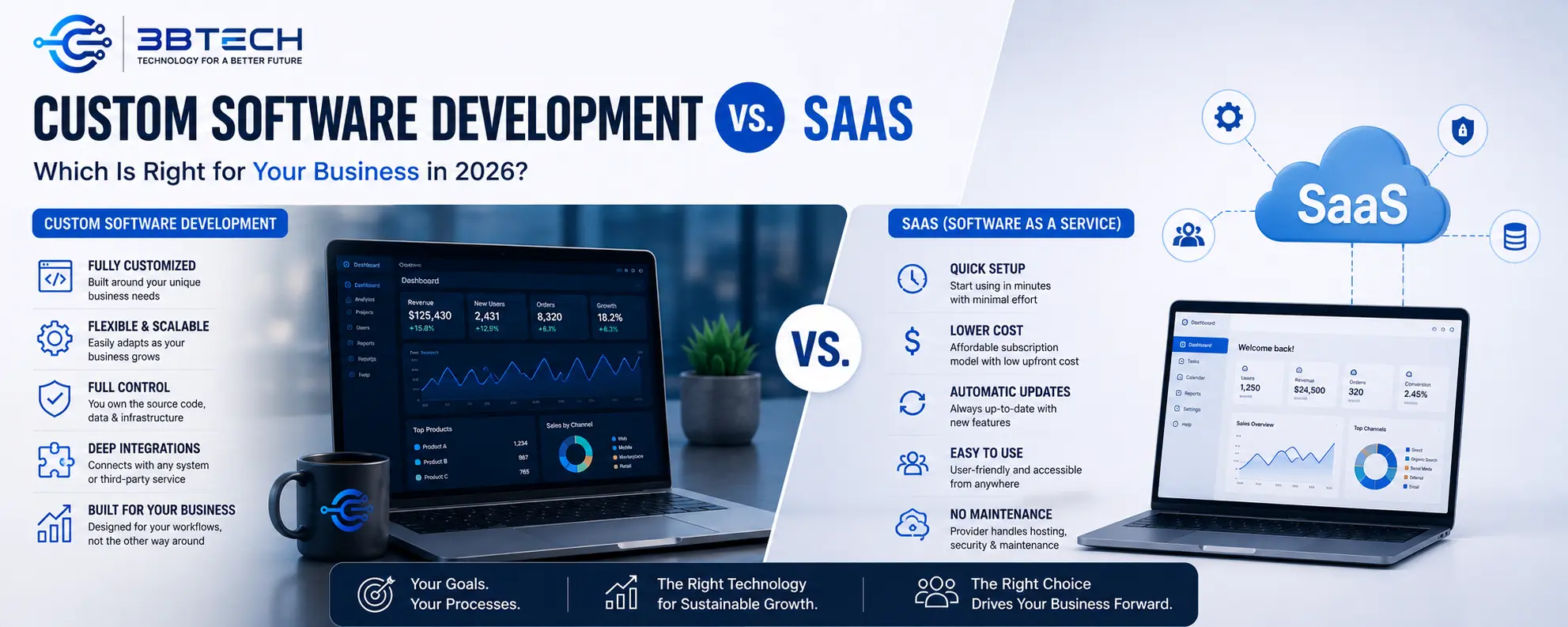
The biggest advantage is flexibility. Features, integrations, user roles, workflows, dashboards, and automation can all be designed around your specific requirements.
However, custom software usually requires a larger initial investment and a longer development process compared with subscribing to an existing SaaS product.
What Is SaaS?
SaaS, or Software as a Service, provides software through the internet, usually through a monthly or annual subscription.
Instead of purchasing and maintaining the underlying infrastructure yourself, the SaaS provider manages the platform, hosting, updates, security, and technical maintenance.
Popular SaaS products are used for everything from accounting and project management to customer relationship management, marketing, communication, and ecommerce.
For businesses that need standard functionality quickly, SaaS can be an excellent option.
The trade-off is that you’re generally working within the features, integrations, pricing structure, and limitations defined by the software provider.
Custom Software vs SaaS: What Is the Difference?
The biggest difference comes down to control and flexibility.
With SaaS, you are adopting an existing solution and configuring it to fit your business as much as the platform allows.
With custom software, the solution is built around your business from the beginning.
Here’s a simplified comparison:
| Factor | Custom Software | SaaS |
|---|---|---|
| Initial Investment | Usually higher | Usually lower |
| Deployment | Requires development | Usually quick |
| Customization | Very high | Limited to available features |
| Scalability | Designed around your needs | Depends on provider |
| Integrations | Can be built specifically | Depends on available integrations |
| Maintenance | Your responsibility/partner | Provider managed |
| Data Control | Greater control | Depends on provider |
| Pricing | Project-based + maintenance | Subscription-based |
| Ownership | Can be owned by business | Usually provider-owned |
| Flexibility | High | Moderate |
Neither option is automatically better. The right choice depends on what your business actually needs.
Custom Software vs SaaS: Cost Considerations
Cost is often one of the first things businesses consider when comparing custom software vs SaaS.
SaaS usually has a lower starting cost. You pay a recurring subscription and can begin using the platform without funding an entire development project.
However, subscription costs can increase as your company grows. You may need additional users, premium features, integrations, storage, or higher service tiers.
Custom software typically requires a larger upfront investment. You are paying for discovery, design, development, testing, deployment, and potentially ongoing maintenance.
But once developed, the business has much greater control over the software and its future development.
The better question isn’t simply:
“Which option costs less?”
Instead, consider:
“Which option provides the better long-term value for our business?”
A SaaS platform may be more economical for a standard business process. Custom software can make more sense when software is directly connected to your competitive advantage or operational efficiency.
When Should You Choose Custom Software?
Custom software can be a strong choice when your business has requirements that existing platforms cannot handle effectively.
1. Your Processes Are Highly Specific
If your workflows are unique, constantly changing, or difficult to manage using standard software, a custom solution can be designed around those processes.
2. You Need Multiple Systems to Work Together
Businesses often use CRM, ERP, ecommerce, accounting, inventory, logistics, and marketing platforms.
If employees constantly move information between systems manually, custom development and API integration can help connect these platforms.
3. Your Business Is Scaling
As your organisation grows, processes that worked for a small team may become inefficient.
Custom software can be designed with future users, departments, data volumes, and functionality in mind.
4. Software Is Part of Your Competitive Advantage
If technology is central to how you deliver your product or service, relying entirely on a third-party platform may limit your ability to innovate.
A custom solution gives you greater control over your technology roadmap.
5. You Need Greater Control
Some businesses require more control over data, functionality, user permissions, integrations, or security.
Custom development can provide a much greater level of control than a standard SaaS platform.
When Is SaaS the Better Choice?
SaaS can be the right choice when you need proven functionality without the time and investment involved in developing your own platform.
SaaS may make sense when:
- You need software quickly.
- Your requirements are relatively standard.
- You have a limited initial budget.
- You don’t need extensive customization.
- The SaaS platform already integrates with your existing tools.
- You prefer predictable subscription costs.
- You want the provider to manage hosting and maintenance.
For example, if your business simply needs project management, email marketing, accounting, or standard CRM functionality, building custom software may not be necessary.
Scalability: Custom Software vs SaaS
Scalability is another important consideration.
A SaaS platform may scale easily when you need additional users or features, but you remain dependent on the provider’s infrastructure and product roadmap.
Custom software gives you greater control over how the system evolves.
A well-designed custom platform can be developed with future requirements in mind, including additional users, new integrations, increased data volumes, automation, and new business processes.
However, scalability isn’t automatic. Custom software needs to be designed and architected properly from the beginning.
Security and Data Control
Security requirements vary significantly between businesses.
Many established SaaS providers invest heavily in security, infrastructure, monitoring, backups, and compliance. This can make SaaS an attractive option for businesses that don’t want to manage those responsibilities internally.
Custom software, meanwhile, can provide greater control over how data is stored, accessed, processed, and integrated with other systems.
That doesn’t automatically make custom software more secure.
Security depends on architecture, development practices, infrastructure, access controls, monitoring, updates, and ongoing maintenance.
For businesses with complex security requirements, the ability to design these elements around their specific environment can be valuable.
Integration With Existing Business Systems
Integration is one area where custom software can provide significant advantages.
A growing business might rely on several platforms:
CRM + ERP + Ecommerce + Accounting + Inventory + Marketing
When these systems don’t communicate effectively, employees may have to enter information manually or work across multiple disconnected platforms.
Custom software can act as a central layer connecting these systems through APIs and other integration methods.
This can help reduce repetitive work, improve data consistency, and provide teams with a clearer view of business operations.
Can You Combine Custom Software and SaaS?
Yes and many businesses should.
Choosing between custom software and SaaS doesn’t always have to be an either-or decision.
A business might use SaaS for accounting, communication, or CRM while developing a custom platform for its unique operational processes.
For example:
SaaS CRM + Ecommerce Platform + Custom Business Application + ERP Integration
This hybrid approach can provide the best of both worlds.
You use established SaaS products where they make sense and build custom functionality where your business needs something more specific.
How to Decide Between Custom Software and SaaS
Before making a decision, ask these questions:
Does the SaaS platform support our core workflows?
If the answer is yes, SaaS may be sufficient.
Are employees working around software limitations?
If your team constantly uses spreadsheets, manual workarounds, or disconnected tools, custom development may be worth considering.
How important is software to our competitive advantage?
The more central technology is to your business model, the stronger the case for custom software may become.
Will our requirements change significantly?
Businesses expecting significant growth or operational changes should consider how easily the chosen solution can evolve.
How many systems need to be integrated?
If you need complex integrations across multiple platforms, custom development can provide more flexibility.
Custom Software Development vs SaaS: Which Is Right for Your Business?
There is no universal answer.
SaaS is often the better choice when you need standard functionality quickly and want to minimise initial development costs.
Custom software is often the better choice when your workflows are unique, software is strategically important, or you need extensive customization and integration.
For many growing businesses, the best solution may actually be a combination of both.
The goal isn’t to choose the most technically impressive option. It’s to choose the technology that solves your business problems, supports your customers, and provides sustainable value as your organisation grows.
Final Thoughts
The decision between custom software development vs SaaS should be based on your actual business requirements rather than simply comparing monthly subscription costs with development quotes.
Look at your current processes, future growth, integration requirements, data needs, internal resources, and long-term technology strategy.
If an existing SaaS product solves your problem effectively, there may be little reason to build something from scratch.
But if your business is being held back by software limitations, disconnected systems, manual processes, or inflexible platforms, custom software could provide the flexibility you need to move forward.
At 3BTech, we help businesses evaluate their technology requirements and develop custom software solutions designed around their operational goals, users, integrations, and future growth.
Ready to explore whether custom software is right for your business?
Frequently Asked Questions
Is custom software better than SaaS?
Not necessarily. SaaS is often better for standard business requirements, while custom software can be more suitable when a business needs unique workflows, advanced integrations, or greater control.
Is custom software more expensive than SaaS?
Custom software generally requires a larger initial investment, while SaaS usually has a recurring subscription cost. The right comparison should consider total cost and long-term business value.
How long does custom software development take?
The timeline depends on the complexity of the project, number of features, integrations, design requirements, testing, and deployment. A simple application can take significantly less time than a large enterprise platform.
Can custom software integrate with SaaS platforms?
Yes. Custom applications can often integrate with SaaS platforms through APIs and other integration methods, depending on the capabilities of each platform.
Is SaaS good for small businesses?
Yes. SaaS can be an excellent option for small businesses that need affordable access to established functionality without managing their own software infrastructure.
When should a business move from SaaS to custom software?
Businesses may consider custom development when existing SaaS platforms can no longer support their workflows, integration requirements, scalability needs, or strategic goals.