Choosing the right software development partner can have a major impact on the success of a digital project.
Whether you are building a new business application, launching a SaaS product, improving an ecommerce platform, replacing outdated software, or connecting different systems, the company you choose will influence much more than the code itself.
A good development partner should understand your business, your users, your technical requirements, and where you want the project to go in the future. A good custom software development company should be able to help you refine these requirements rather than simply accepting a long list of features without questioning their purpose
With so many agencies and development companies available, it can be difficult to know which one is actually right for your business.
This guide explains how to choose a software development company in 2026, what to look for before signing a contract, which questions to ask, and how to avoid common mistakes.
What Does a Software Development Company Actually Do?
A software development company helps businesses plan, design, build, test, launch, and maintain digital products and applications.
Depending on the company, services may include custom business software, web applications, mobile apps, SaaS platforms, ecommerce development, API integrations, automation, cloud solutions, and ongoing technical support.
The important thing to understand is that development is not simply about writing code.
A successful project usually involves several stages, including understanding requirements, planning the architecture, designing the user experience, developing the software, testing it, deploying it, and improving it after launch.
That is why choosing a software development company should be based on more than a list of programming languages or technologies.
1. Start With Your Business Requirements
Before comparing development companies, be clear about what you actually need.
You don’t necessarily need to have every feature documented. In fact, many businesses approach developers because they need help turning an idea into a practical technical solution.
However, you should understand the basic problem you are trying to solve.
Ask yourself:
- What problem should the software solve?
- Who will use it?
- What processes should it improve?
- What systems does it need to connect with?
- Do you need a web application, mobile app, SaaS platform, or internal business software?
- What would success look like after launch?
A good custom software development company should be able to help you refine these requirements rather than simply accepting a long list of features without questioning their purpose.
Discuss Your Software Project →
2. Look for Relevant Development Experience
Not every development company is suitable for every project.
A team that specialises in simple websites may not be the right choice for an enterprise application. Similarly, a company experienced in mobile apps may not have the expertise required for complex ecommerce integrations or internal business systems.
Look for experience that is relevant to your project.
For example, if you need a business platform that connects CRM, inventory, accounting, and ecommerce systems, ask whether the development team has handled similar integrations.
If you are launching a SaaS product, look for experience with user management, subscription systems, dashboards, APIs, cloud infrastructure, and scalable architecture.
Don’t Just Look at the Portfolio
A portfolio can tell you what a company has built, but it doesn’t always explain how the project was delivered.
Ask about:
- The original business problem
- The development process
- Technical challenges
- Integrations involved
- Project duration
- Post-launch support
- Results achieved
This gives you a much better understanding of the company’s actual capabilities.
3. Check Their Technical Expertise
Technology choices should support your project rather than drive it.
A professional development team should be able to explain why a particular technology, framework, database, architecture, or integration approach is appropriate for your requirements.
Depending on your project, you may need expertise in:
- Web application development
- Mobile app development
- Cloud platforms
- APIs
- Database architecture
- Ecommerce
- SaaS development
- AI integration
- Business automation
- CRM and ERP integration
- Cybersecurity
- Performance optimisation
You don’t need to become a technical expert yourself.
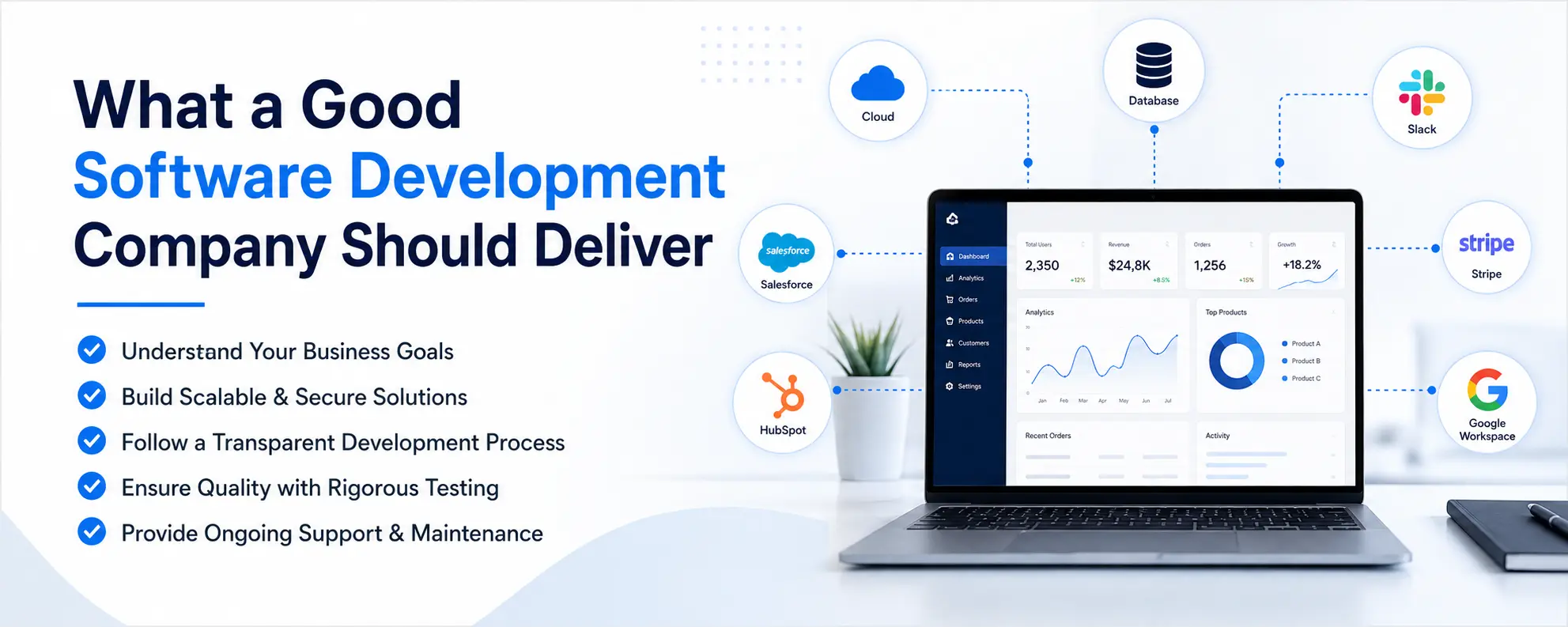
What matters is whether the software development agency can explain technical decisions in a way that makes sense to your business.
4. Evaluate Their Development Process
One of the biggest differences between development companies is how they manage projects.
A good development process should give you visibility into what is being built, why it is being built, and what happens next.
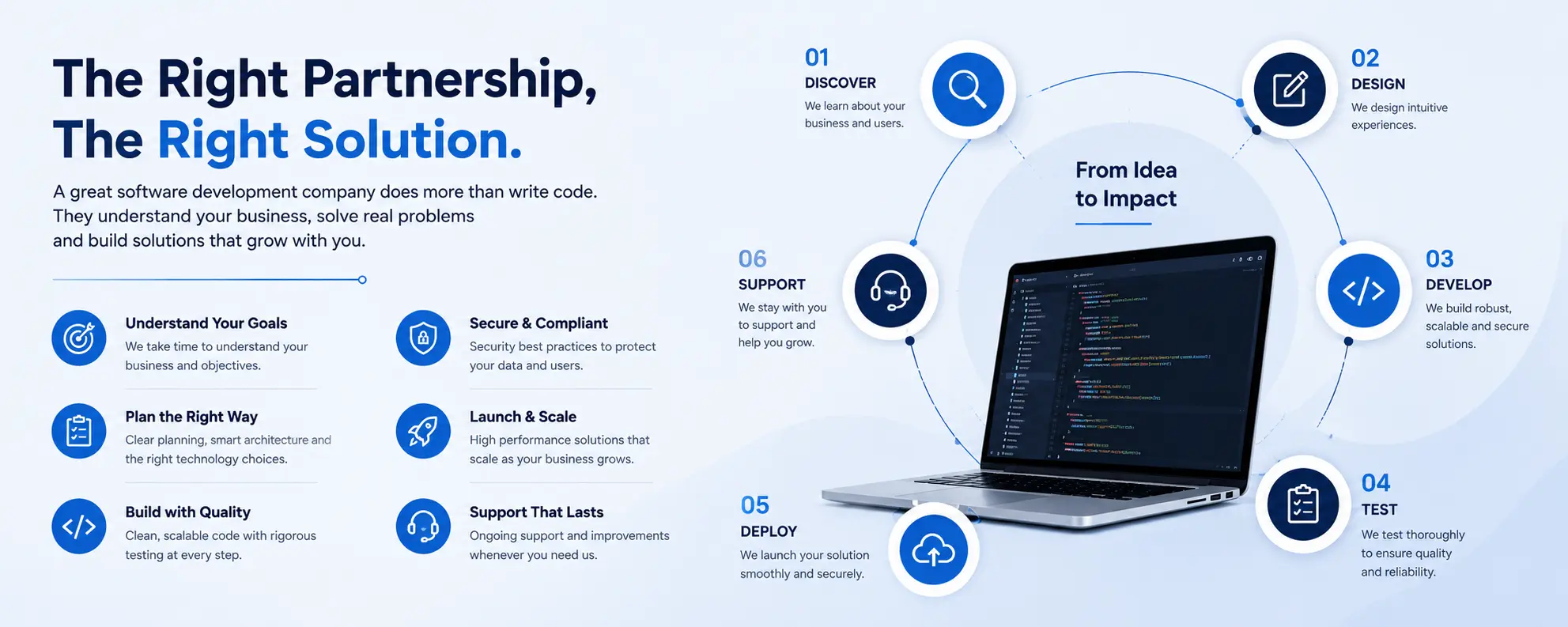
A typical process may include:
Discovery and Planning
The team understands your business, users, objectives, existing systems, and technical requirements.
UI/UX Design
The user journey and interface are planned before development begins.
Development
The software is built in stages, with regular reviews and testing throughout the project.
Quality Assurance
The product is tested for functionality, usability, performance, compatibility, and security.
Launch and Support
The software is deployed and then maintained, monitored, and improved as your requirements evolve.
Don’t be afraid to ask a potential development partner to explain their process before you start.5. Make Sure Communication Is Clear
Technical expertise is important, but communication can make or break a project.
You should understand:
- Who will manage your project
- How often you will receive updates
- Where project discussions will take place
- How changes are handled
- How quickly questions are answered
- Who makes technical decisions
- How progress is reported
You should never feel like you have to chase your development team to find out what is happening.
The best development partnerships are collaborative. You should be able to discuss priorities, raise concerns, review progress, and make informed decisions throughout the project.
Explore Custom Software Development
6. Ask How They Handle Security
Security should not be treated as something added at the end of development.
Your development partner should consider security throughout the software lifecycle, including architecture, authentication, access controls, data handling, testing, deployment, and maintenance.
The UK Government’s Software Security Code of Practice provides a useful baseline for evaluating software security and resilience, including secure development, testing, third-party components, and secure-by-design practices.
The NCSC also recommends principles such as protecting code repositories, securing development environments, testing continuously, and planning for security flaws.
For web applications, the OWASP Top 10 is another useful reference when discussing common application security risks with a development partner.
Questions to Ask About Security
Ask your development company:
- How is user data protected?
- How are permissions managed?
- How is sensitive information handled?
- What security testing is performed?
- How are vulnerabilities identified?
- How are third-party dependencies managed?
- What happens if a security issue is discovered after launch?
A company that takes these questions seriously is much easier to trust with an important digital product.
7. Understand Their Approach to Scalability
Your software should solve today’s problem without creating tomorrow’s problem.
A solution that works for 100 users may not be suitable for 10,000 users.
Before choosing a development partner, discuss how the software can evolve as your business grows.
This includes:
- Database design
- Application architecture
- Hosting
- Performance
- API architecture
- Security
- User management
- Infrastructure
- Future integrations
A strong software development company should think beyond the first version of your product.
The goal isn’t necessarily to build everything on day one. It is to create a foundation that allows you to add functionality when the business needs it.
8. Check Their Testing and Quality Assurance Process
A product isn’t finished simply because the development team says the coding is complete.
Software needs to be tested across different scenarios before it reaches customers.
Ask whether the company performs:
- Functional testing
- Browser testing
- Mobile responsiveness testing
- Performance testing
- Security testing
- Integration testing
- User acceptance testing
- Regression testing
Testing is particularly important when software connects multiple platforms.
One change in an ecommerce platform, API, database, or third-party service can affect another part of the system.
A structured QA process helps identify these issues before they become expensive problems.
9. Consider Long-Term Support
Launching software is only the beginning.
After launch, your business may need:
- Bug fixes
- Security updates
- Performance improvements
- New features
- API updates
- Third-party integration changes
- Infrastructure maintenance
- Technical support
Ask potential development partners what happens after the initial project is completed.
Do they offer maintenance?
Can they continue developing the platform?
Who handles urgent issues?
Is support included or charged separately?
A long-term relationship can be valuable because the development team gradually becomes familiar with your systems, business processes, and technical architecture.
10. Compare Development Companies Based on Value, Not Just Price
Price is obviously important, but choosing the cheapest development company is rarely the best strategy.
A low initial quote can become expensive if:
- Requirements were misunderstood
- The architecture was poorly planned
- Testing was limited
- Communication was weak
- Important features were missed
- The project requires extensive rebuilding later
Instead of asking only:
“How much will it cost?”
Ask:
“What am I getting for that investment?”
Compare companies based on:
- Experience
- Technical expertise
- Development process
- Communication
- Security
- Scalability
- QA
- Support
- Ownership
- Long-term value
The best software development company isn’t necessarily the cheapest or the largest.
It is the company that can deliver the right solution for your business.
Software Development Company vs Software Development Agency: What’s the Difference?
You will often see both terms used online.
A software development company typically focuses on designing and developing software products and applications.
A software development agency can offer a broader combination of strategy, design, development, marketing, ecommerce, or digital services depending on its structure.
There is no universal rule that one is better than the other.
What matters is whether the team has the specific skills and experience your project requires.
Instead of focusing too heavily on the label, look at the actual services, portfolio, development process, technical team, and client experience.
Choosing a Software Development Company in the UK
For businesses operating across the UK, the right development partner should understand both technical requirements and the practical needs of the local business environment.
A Software Development Company in the UK can help businesses build custom applications, automate processes, connect existing platforms, and develop scalable digital products.
When comparing UK development companies, pay particular attention to their experience with businesses similar to yours and their ability to provide ongoing technical support.
Choosing a Software Development Company in London
London businesses operate across a wide range of sectors, including financial services, technology, ecommerce, healthcare, professional services, media, and startups.
These businesses often have complex requirements involving multiple platforms, customer systems, internal applications, and data.
A Software Development Company in London should therefore be able to understand more than just the technical side of development.
Look for a team that can understand your workflows, integrate existing systems, and build software around the way your organisation operates.
Choosing a Software Development Company in Manchester
Manchester has a strong digital and technology ecosystem, with businesses across software, ecommerce, finance, healthcare, manufacturing, media, and other industries.
For growing companies, technology often needs to evolve alongside the business.
A Software Development Company in Manchester can help organisations develop custom applications, modernise outdated systems, automate workflows, and connect different business platforms.
The key is finding a development partner that understands both the immediate project and the longer-term business objectives.
Choosing a Software Development Company in Dubai
Businesses in Dubai operate across highly diverse industries, including ecommerce, finance, real estate, professional services, hospitality, logistics, and technology.
As these businesses grow, they may require custom applications, integrations, automation, mobile platforms, and scalable digital infrastructure.
A Software Development Company in Dubai can help businesses develop technology around their specific operational requirements rather than forcing teams to work around generic software.
Questions to Ask Before Hiring a Software Development Company
Before signing a contract, ask potential partners these questions:
About Experience
- Have you built something similar before?
- Can you show relevant examples?
- What industries have you worked with?
About Development
- What technology would you recommend and why?
- How do you handle testing?
- How do you approach security?
- How will the software scale?
About Communication
- Who will manage the project?
- How often will we receive updates?
- How will changes to requirements be handled?
About Ownership
- Who owns the source code?
- Who owns the intellectual property?
- Will we have access to our repositories and documentation?
About Support
- What happens after launch?
- Do you provide maintenance?
- How are security updates handled?
- What happens if we need new features?
The answers to these questions can reveal a lot more than a polished sales presentation.
Red Flags to Watch For
Choosing a development partner becomes easier when you know what to avoid.
Be cautious if a company:
- Promises an unrealistically short development timeline
- Gives a price without understanding the requirements
- Cannot explain its development process
- Avoids discussing security
- Has no clear testing process
- Doesn’t explain ownership of source code
- Is difficult to communicate with before the project starts
- Cannot provide relevant examples
- Pushes unnecessary technology
- Offers a very low quote without explaining what is included
A good development company should be comfortable discussing both the opportunities and limitations of a project.
What Should a Good Software Development Proposal Include?
Before choosing a development partner, ask for a proposal that clearly explains the project.
A useful proposal should cover:
- Project objectives
- Scope of work
- Key features
- Technology approach
- Integrations
- UI/UX requirements
- Development stages
- Testing
- Estimated timeline
- Pricing
- Payment structure
- Support
- Maintenance
- Ownership
- Assumptions and exclusions
This makes it much easier to compare different companies fairly.
How Much Does Software Development Cost in 2026?
There is no single price for software development.
The cost depends on the complexity of the product, number of features, design requirements, integrations, technology choices, security requirements, team structure, and ongoing support.
A simple internal application can have very different requirements from a large SaaS platform or enterprise system.
Instead of looking for a generic price online, define the scope first.
A professional development company should be able to explain what is driving the cost and where the budget is being allocated.
This also makes it easier to identify opportunities for an MVP rather than trying to build every possible feature in the first version.
Should You Choose a Local or Remote Development Company?
Location is no longer the only factor that determines whether a development team is suitable.
A remote team can work effectively if communication, documentation, project management, and technical processes are strong.
At the same time, businesses may prefer a development partner in their own region because of timezone, communication, meetings, industry familiarity, or other practical considerations.
The better question is:
Can this team work effectively with our business?
Consider:
- Timezone compatibility
- Communication
- Project management
- Technical expertise
- Availability
- Support
- Relevant experience
- Long-term relationship
The right combination matters more than the physical location alone.
What Makes a Software Development Company the Right Choice?
Ultimately, the right partner is the one that understands what your business is trying to achieve.
You want a team that can challenge ideas when necessary, explain technical decisions clearly, identify potential problems early, and build software that can evolve with your organisation.
Technical ability is essential, but so are communication, planning, security, testing, and long-term support.
Don’t choose a development partner simply because its website looks impressive.
Choose one because it understands your problem and has a credible plan for solving it.
Final Checklist Before You Choose
Before making your final decision, check whether the company can answer yes to most of these questions:
- Do they understand our business requirements?
- Have they delivered similar projects?
- Can they explain their technical approach?
- Do they have a structured development process?
- Is security considered from the beginning?
- Do they have a proper QA process?
- Can the software scale?
- Is communication clear?
- Is source-code ownership clear?
- Do they offer post-launch support?
- Is their proposal transparent?
- Does their approach fit our budget and timeline?
If the answer is yes, you are much more likely to have found a suitable development partner.
Frequently Asked Questions
How do I choose a software development company?
Start by defining your business requirements and then compare companies based on relevant experience, technical expertise, communication, security, development processes, testing, pricing, and long-term support.
What should I look for in a software development company?
Look for relevant experience, a clear development process, strong communication, technical expertise, secure development practices, proper testing, scalability, and post-launch support.
Is a software development agency better than a freelancer?
It depends on the project. A freelancer may be suitable for a smaller project, while a development agency can be more appropriate when you need multiple disciplines, ongoing support, complex integrations, or a larger development team.
How much does custom software development cost?
The cost depends on the complexity of the software, number of features, integrations, design requirements, security, technology, development team, and ongoing support.
Should I build an MVP first?
An MVP can be a good approach when you want to validate an idea before investing heavily in a full product. The right MVP should focus on the features required to test the core business proposition rather than simply being a smaller version of everything you eventually want to build.
Why is security important when choosing a development company?
Security should be considered throughout the software lifecycle. The UK’s Software Security Code of Practice and NCSC guidance both emphasise secure development, testing, maintenance, and supplier/customer communication.
Ready to Choose the Right Development Partner?
Choosing a software development company is a long-term decision.
The right team should help you understand the problem, choose the appropriate technology, build a secure and scalable solution, and continue supporting the software as your business grows.
Whether you are starting with an idea or looking to modernise an existing platform, the best development relationship starts with a clear understanding of what your business actually needs.