

Artificial intelligence has completely changed how mobile applications are planned, designed, and developed. Today, AI coding assistants and app-building platforms can generate interfaces, write code, connect APIs, and create working prototypes in a fraction of the time traditional development once required.Understanding why AI-generated apps fail can help businesses avoid costly development mistakes before launching a product.
For startups, entrepreneurs, and businesses, this sounds like the perfect opportunity: build faster, spend less, and launch sooner. But there is an important difference between generating a working app and building a successful digital product.
Many AI-generated apps look impressive in a demo but struggle when real users arrive. Some experience performance issues, security vulnerabilities, confusing interfaces, scaling problems, or code that becomes difficult to maintain. Why AI-generated apps fail is becoming an important question for startups, entrepreneurs, and businesses as artificial intelligence transforms mobile app development. AI tools can now generate code, design interfaces, connect APIs, and create working prototypes faster than ever before.
So, why do AI-generated apps fail?
The answer is rarely that AI cannot write code. The bigger problem is that successful app development requires more than code generation. It involves product strategy, user research, security, scalable architecture, testing, monitoring, and continuous improvement.
In this guide, we’ll explore 10 common AI app development mistakes and explain how businesses can avoid them when building an AI-powered application in 2026.
Are AI-Generated Apps Actually Reliable?
AI-generated apps can be reliable, but only when the code, architecture, security, and user experience are properly reviewed and tested.
Modern AI tools can create functional prototypes and generate significant portions of an application. However, code that works in a controlled demo may not be ready to handle thousands of users, online payments, personal information, third-party APIs, or unexpected user behavior.
This is one of the biggest AI app development challenges businesses face today. The speed of AI can create a false sense of completion. An app may look finished while important technical risks remain hidden beneath the surface.
The strongest approach is not choosing between AI and human developers. It is combining AI’s speed with professional expertise in architecture, security, UI/UX, testing, and long-term product development.
1. Building an App Without Validating the Idea
One of the biggest reasons AI-generated apps fail has nothing to do with the technology itself.
AI makes it incredibly easy to turn an idea into a prototype. But building faster does not mean people actually need the product.
Before development begins, businesses should understand who their target users are, what problem the app solves, how people currently solve that problem, and why they would switch to a new solution.
Imagine building an advanced AI productivity app with 30 features when users only need a simple tool that saves them ten minutes every day. More features do not automatically create more value.
How to Avoid This Mistake
Validate your idea through customer interviews, surveys, competitor research, landing pages, or an MVP before investing heavily in full development.Another reason why AI-generated apps fail is that businesses often treat AI-generated code as a finished product rather than a starting point.
AI can accelerate development, but it cannot replace genuine market demand.
2. Treating AI-Generated Code as Production-Ready
A common mistake when building apps with AI is assuming that code is production-ready simply because it works.
AI-generated code may contain duplicated logic, weak error handling, outdated dependencies, inefficient queries, hard-coded values, or inconsistent programming patterns. These problems might not appear during the initial demo but can become serious as the application grows.
Why Professional Code Review Matters
Experienced developers don’t only ask whether the code works today. They also consider whether it is secure, scalable, maintainable, testable, and easy to improve in the future.
If you’re planning a serious digital product, professional mobile app development services can help turn an initial concept or AI-assisted prototype into a more robust application designed for real users and long-term growth.
3. Ignoring Scalability Until the App Starts Growing
An app with 50 users has very different infrastructure requirements from an app serving 50,000 people every day.
Many AI-built apps perform well during testing but begin struggling when traffic increases. Pages become slow, database queries time out, API limits are exceeded, and users experience errors.
Scalable app development requires thoughtful decisions about database architecture, cloud infrastructure, caching, APIs, background processing, and performance monitoring.
Not every MVP needs enterprise-level infrastructure from day one. However, the technical foundation should allow reasonable growth without requiring the entire application to be rebuilt.
Businesses developing complex platforms may also benefit from custom software development solutions designed around their specific workflows, users, and long-term growth requirements.
4. Neglecting Security and User Data Protection
Security is one of the most serious reasons why AI-generated apps fail after launch.
Mobile applications may collect names, email addresses, passwords, payment details, locations, private messages, or sensitive business information. A single vulnerability can damage customer trust and create significant financial and reputational consequences.
Common risks can include exposed API keys, weak authentication, insecure data storage, missing encryption, vulnerable dependencies, poor access controls, and insufficient input validation.
Security Should Start From Day One
Security should be considered throughout the development lifecycle, not added as a final feature before launch.
This includes secure authentication, encrypted communications, protected credentials, appropriate authorization, dependency monitoring, secure APIs, and regular security testing.
The OWASP Mobile Application Security project provides widely recognized guidance for improving mobile application security and identifying common risks.
5. Building Too Many Features Before Testing With Users
AI makes feature development faster, but that can lead to feature overload.
A simple app idea begins with five essential features. Then ten more are added. Soon, the MVP becomes a complicated platform that takes longer to test, costs more to maintain, and confuses users.
Every additional feature introduces more code, potential bugs, testing requirements, security considerations, and maintenance work.
Start With the Smallest Valuable Product
Instead of asking, “What else can we add?”, ask:
“What is the smallest set of features users genuinely need to solve their main problem?”
Build that version first. Observe real user behavior, collect feedback, and then improve the product based on evidence rather than assumptions.
6. Poor UI/UX Makes Even Powerful Apps Difficult to Use
An application can use advanced artificial intelligence and still fail because users don’t understand how to use it.
Good UI/UX is not only about beautiful colors and animations. It is about helping users complete important actions easily and without confusion.
Poor user experiences often include complicated onboarding, unclear buttons, confusing navigation, too many steps, overloaded dashboards, and inconsistent interfaces.
AI can generate impressive UI concepts quickly, but understanding real users requires more than visual generation. Professional design considers accessibility, user expectations, device limitations, business goals, and the complete customer journey.
Successful applications make complicated technology feel simple.
7. Skipping Real-World Testing
An application working perfectly on a developer’s device does not mean it will work for every user.
People use different phones, operating systems, screen sizes, network speeds, and accessibility settings. An app may perform perfectly on the latest iPhone but crash on an older Android device. A payment flow may work on fast Wi-Fi but fail on an unstable mobile connection.
Testing should include functionality, usability, security, performance, compatibility, and third-party integrations.
Both Apple’s App Review Guidelines and Android Developers documentation provide important guidance for developers preparing apps for their respective platforms.
Testing should not be treated as one final task. It should happen throughout the development process.
8. Depending Too Heavily on Third-Party AI Tools and APIs
Modern AI applications often rely on external services for language models, image generation, voice recognition, authentication, payments, analytics, maps, and other functionality.
These services can dramatically accelerate AI mobile app development, but excessive dependency creates risk.
A provider may increase prices, change usage limits, modify an API, experience downtime, or discontinue a feature. If an entire application depends on one external service without a contingency plan, one change can affect the whole business.
Businesses should identify critical dependencies, monitor usage and costs, implement graceful error handling, and consider backup options where practical.
The goal isn’t to avoid third-party services. It’s to use them strategically without creating unnecessary business risk.
9. Launching Without Analytics or User Feedback
How do you know why users leave your application?
Which features do they use most? Where do they abandon registration? What causes crashes? Which screens are too slow?
Without analytics and monitoring, businesses are often guessing.
Depending on the type of application, important metrics may include active users, retention rate, churn, session duration, feature adoption, conversions, crash rates, API errors, and loading times.
Analytics show what users are doing. Direct feedback can help explain why.
AI can help analyze large amounts of feedback and identify patterns, but businesses still need a process for acting on those insights.
10. Thinking Development Ends When the App Launches
One of the biggest misconceptions about AI-built apps is that development ends at launch.
In reality, launch is often the beginning.
Applications need bug fixes, security updates, performance improvements, operating system compatibility updates, API changes, infrastructure scaling, and new features based on genuine customer feedback.
Apple and Google regularly update their platforms. Third-party services change. Security vulnerabilities emerge. Customer expectations evolve.
An app that is never maintained will eventually become outdated, unstable, or insecure.
Before launching, businesses should know who will monitor performance, handle critical bugs, manage security updates, maintain APIs, and prioritize future improvements.
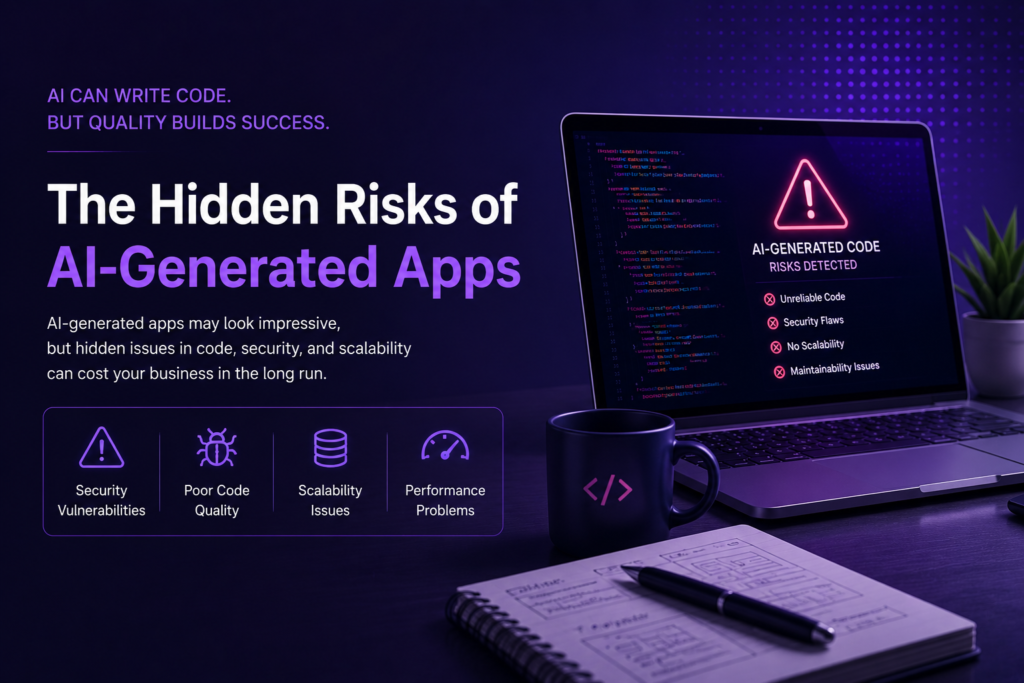
Why AI-Generated Apps Fail After Launch
So, why do AI-generated apps fail after launch?
Usually, it is not because artificial intelligence is incapable of producing useful code. Failure often happens because the development process focuses entirely on generating the application while ignoring everything surrounding it.
A successful mobile product requires a validated idea, clear strategy, reliable architecture, strong security, thoughtful UI/UX, comprehensive testing, analytics, monitoring, and ongoing maintenance.
AI can accelerate many of these processes, but speed alone cannot guarantee success.
The difference between a quick prototype and a sustainable product often comes down to the quality of the decisions made around the code.To understand why AI-generated apps fail after launch, businesses must look beyond code and focus on security, scalability, testing, and user experience.
Understanding why AI-generated apps fail requires looking beyond code generation and focusing on the complete product lifecycle. One major reason why AI-generated apps fail is that businesses often launch applications without proper security reviews, scalability planning, real-world testing, or ongoing maintenance. By understanding why AI-generated apps fail, startups and growing businesses can avoid costly mistakes and build more secure, reliable, and scalable digital products that deliver long-term value to users.
How to Build a Successful AI-Generated App
The best way to avoid common AI app development mistakes is to use a structured process.
Start with a real user problem rather than building an app simply because AI is popular. Validate demand before investing in a complete product, and focus your MVP on essential features.
AI-generated code should be reviewed for security, performance, maintainability, and scalability. The application should be tested on real devices and under realistic conditions.
Most importantly, plan beyond launch. Use analytics, performance monitoring, crash reporting, and customer feedback to continuously improve the product.
AI should be used as a powerful accelerator not as a replacement for product strategy, engineering judgment, security, or understanding your users.
Understanding why AI-generated apps fail is essential for businesses that want to turn an AI-powered idea into a reliable digital product. In many cases, why AI-generated apps fail comes down to poor planning, weak security, limited testing, and the assumption that AI-generated code is automatically ready for real users. By learning why AI-generated apps fail, startups and businesses can make better technical decisions, reduce development risks, and create applications that are more secure, scalable, and valuable over the long term.
AI-powered mobile apps are transforming how businesses create smarter, faster, and more personalized digital experiences. Understanding why AI-generated apps fail helps businesses identify technical weaknesses before they become expensive problems. From security and scalability to testing and user experience, understanding these common AI app development failures allows companies to make better decisions and build more reliable applications designed for long-term growth.
Frequently Asked Questions About AI-Generated Apps
Why do AI-generated apps fail?
AI-generated apps often fail because of poor idea validation, weak architecture, security vulnerabilities, scalability problems, limited testing, poor UI/UX, or lack of post-launch maintenance.
Are AI-built apps reliable?
Yes, AI-built apps can be reliable when their code, architecture, security, integrations, and performance are properly reviewed and tested before launch.
Can AI build a complete mobile app?
AI can generate significant portions of an application and create functional prototypes. However, complex production apps still require careful decisions around security, architecture, testing, deployment, scalability, and maintenance.
What are the biggest AI app development mistakes?
The biggest mistakes include building without market validation, trusting generated code without review, ignoring security, adding too many features, failing to plan for growth, skipping real-world testing, and neglecting ongoing maintenance.
Do I still need developers if AI can generate code?
For basic prototypes, AI may reduce the amount of manual development required. For complex or business-critical applications, experienced developers remain valuable for architecture, security, integrations, testing, scalability, and long-term maintenance.
Final Thoughts: AI Can Build Faster, but Success Requires More Than Code
Understanding why AI-generated apps fail is not an argument against artificial intelligence.
AI is transforming software development and allowing businesses to prototype faster, automate repetitive work, explore new ideas, and reduce development time.
But a successful app needs more than generated code.
The applications most likely to succeed are built around genuine user needs, supported by strong technical foundations, protected by appropriate security, tested under real-world conditions, and continuously improved after launch.
The best approach is to combine AI’s speed with human expertise, strategic thinking, and responsible engineering.
Ready to Build an AI-Powered Mobile App That Can Grow With Your Business?
Have an AI-powered app idea but want to avoid the mistakes that cause promising products to fail?
3BTech helps startups, growing businesses, and enterprises turn ideas into secure, scalable, and user-friendly mobile applications. From strategy and UI/UX to iOS, Android, cross-platform development, AI integrations, testing, deployment, and ongoing support, we help build products designed for real-world growth.
Whether you’re validating an MVP or planning a sophisticated AI-powered platform, the right technical foundation can make the difference between simply launching an app and building a product users continue to trust.
How to Choose the Best Mobile App Development Company for Your Business in 2026
Local SEO for Small Businesses: 10 Proven Strategies to Rank Higher and Get More Customers
Why Website Speed Matters for SEO and User Experience
CTA Button: