

You have an app idea. You know the problem you want to solve, you can imagine the features, and perhaps you have already started thinking about design, technology, and launch.
Then comes one of the most important decisions in the entire development process:
Should you build an MVP first or invest in a full app from the beginning?
There is no universal answer. An MVP can help you launch faster, validate demand, and reduce financial risk. But an overly limited MVP can fail to impress users or prove whether the idea truly works. On the other hand, building a complete application too early can consume months of development time and a significant budget before you know whether real users actually want the product.
The wrong choice can cost more than money. It can delay your launch, create unnecessary technical debt, make future scaling difficult, or cause you to solve problems that your users never had.
In 2026, this decision has become even more complex. AI-powered development tools can accelerate prototyping and coding, but faster development does not eliminate the need for product validation, security, scalability, usability, or sound technical judgment.
So, how do you decide between an MVP vs full app?
The right answer depends on your idea, target users, competition, technical complexity, available budget, regulatory requirements, and how much uncertainty exists around your product.
This guide will help you make that decision before expensive development begins.
What Is an MVP?
A Minimum Viable Product, or MVP, is the simplest functional version of a product that delivers its core value to real users and allows you to learn from their behavior and feedback.
The key word is viable.
An MVP should not be a broken, unfinished, or low-quality version of your app. It should solve one important problem well enough that real users can understand the value of the product and meaningfully interact with it.
For example, imagine you want to build a comprehensive fitness application with:
- Personalized workout plans
- AI-powered coaching
- Nutrition tracking
- Social challenges
- Wearable integrations
- Video consultations
- Progress analytics
An MVP may initially focus only on personalized workout plans, progress tracking, and basic recommendations. These features could be enough to test the most important assumption: Will target users consistently use the app to follow personalized fitness programs?
If users engage with the core experience, you have stronger evidence to justify further investment.
An MVP is therefore not simply a smaller app. It is a strategic experiment designed to reduce uncertainty.
What Is a Full App?
A full app is a more comprehensive version of a digital product, typically designed with a broader feature set, polished user experience, stronger integrations, advanced functionality, and infrastructure prepared for a larger range of use cases.
Depending on the product, a full application might include:
- Multiple user roles
- Advanced dashboards
- Third-party integrations
- Subscription and payment systems
- Real-time communication
- AI-powered features
- Detailed analytics
- Advanced security controls
- Administrative tools
- Personalization
- Automation workflows
Building a full app first can make sense when the product requirements are already well validated or when a limited MVP would be unable to deliver meaningful value.
The important distinction is this: more features do not automatically create a better product.
A full app is only the better choice when those additional capabilities are genuinely necessary for the product to work, compete, comply with regulations, or satisfy known user requirements.
MVP vs Full App: The Core Difference
Choosing between MVP vs full app development is one of the most important early decisions for any new digital product.
The right MVP vs full app approach depends on your budget, market validation, technical requirements, and long-term business goals.
Before investing heavily in development, an MVP vs full app comparison can help identify the safest and most practical path forward
The biggest difference between an MVP and a full app is not simply the number of features. It is the amount of uncertainty you are willing to accept before making a larger investment.
An MVP is primarily designed to answer critical questions:
- Do users actually have this problem?
- Will they use this solution?
- Which features matter most?
- Will customers pay for it?
- Does the proposed user experience work?
- Is the business model realistic?
A full app assumes that many of these questions have already been answered with sufficient confidence.
That leads to an important principle:
The greater the uncertainty around your idea, users, or business model, the stronger the case for starting with an MVP.
If demand is already proven, requirements are fixed, and the complete feature set is necessary to deliver value, starting with a fuller product may be more efficient.
Why Building a Full App Too Early Can Be Expensive
One of the most common mistakes in app development is assuming that more features increase the chance of success.
They often increase cost, complexity, and risk instead.
Every additional feature requires more than initial coding. It may also require:
- UX and UI design
- Backend development
- Database changes
- API integrations
- Security considerations
- Testing
- Analytics
- Documentation
- Ongoing maintenance
Suppose you spend six months developing 20 features before launching. After release, user behavior reveals that only five of those features are genuinely important.The MVP vs full app decision should be based on risk, validation, budget, and technical complexity not simply on which option appears cheaper at first.
The remaining 15 still consumed time and budget. Worse, they may continue increasing maintenance costs and making future development more complex.
This is one reason an experienced mobile app development team should challenge unnecessary features rather than simply build everything on the initial wish list.
Good development is not only about writing code. It is also about making informed decisions about what should be built, when it should be built, and why.
When Should You Build an MVP First?
Starting with an MVP is usually the stronger approach when your biggest challenge is uncertainty.
1. You Have an Unvalidated App Idea
You may strongly believe that people need your product, but assumptions are not the same as evidence.
Friends saying, “That’s a great idea,” is not market validation.
A functional MVP allows real target users to experience the product and reveal whether they genuinely find it valuable.
Their actual behavior is usually more reliable than hypothetical opinions.
2. You Are Entering a New or Uncertain Market
If customer behavior, pricing, demand, or market size is unclear, building a complete application immediately creates significant financial risk.
An MVP helps test the market before committing to a larger investment.
3. You Have a Limited Budget
When resources are limited, prioritization becomes essential.
Rather than distributing your budget across many average features, you can focus on building the core experience properly.
However, a limited budget should never justify ignoring essential security, data protection, usability, or technical quality.
Minimum viable does not mean minimum responsible.
4. Speed to Market Matters
Sometimes launching early provides a strategic advantage.
An MVP can help you reach users sooner, gather feedback, test acquisition channels, and start learning while competitors are still planning.
But speed should not come at the expense of fundamental quality. A fast launch with a frustrating or insecure product can damage trust before the business has a chance to grow.
5. You Need Evidence for Investors or Stakeholders
A working product with real users, engagement data, retention signals, or early revenue is often more convincing than a presentation full of projections.
An MVP can help transform an idea into measurable evidence.
When Should You Build a Full App First?
An MVP is not always the correct answer.
There are situations where building a more complete product from the beginning may be necessary.
1. A Limited Product Cannot Deliver Real Value
Some applications only work when several systems operate together.
For example, a marketplace may require seller onboarding, buyer accounts, listings, search, messaging, payments, and order management before the core experience becomes viable.
Removing too much functionality could create a product that technically exists but cannot meaningfully test the business model.
2. Your Requirements Are Already Validated
If you are rebuilding an existing internal system, replacing legacy software, or developing a product based on established workflows, the level of uncertainty may be much lower.
In these cases, a broader initial build can be justified because the organization already knows what users need.
This is particularly relevant in custom software development, where the objective may be to replace known manual processes or outdated systems rather than test a completely new consumer idea.
3. Security or Compliance Requirements Are Non-Negotiable
Healthcare, fintech, enterprise, and other data-sensitive applications may require security, privacy, access control, auditability, or compliance measures from the beginning.
These requirements should not be postponed because a product is called an MVP.
An insecure MVP can expose user data, create legal risks, and damage trust.
4. The Market Has Strong Established Competitors
If users already have access to highly polished alternatives, launching an extremely basic product may fail to demonstrate why they should switch.
You still do not need to copy every competitor feature. But your initial product must provide a sufficiently strong experience or meaningful differentiator.
5. The Product Is Business-Critical
If the application will immediately support important operational workflows, transactions, employees, or customers, a limited experimental product may create unacceptable disruption.
In this situation, reliability and completeness may be more important than rapid validation.
The Biggest Mistake: Confusing an MVP With a Cheap App
One of the most damaging misconceptions is that an MVP is simply the cheapest version of an application.
It is not.
A successful MVP removes unnecessary scope while protecting the quality of what remains.
A poor MVP may have:
- Confusing navigation
- Serious bugs
- Weak security
- Unreliable performance
- No analytics
- Poor architecture
- An unclear value proposition
When users reject such a product, you learn very little.
Did they dislike the idea?
Or did they leave because the app was slow, confusing, buggy, or untrustworthy?
A good MVP should produce useful evidence. If poor execution distorts user behavior, the experiment becomes unreliable.
How AI Is Changing MVP Development in 2026
AI has significantly changed how quickly teams can prototype interfaces, generate code, create test cases, analyze feedback, and automate parts of the software development lifecycle. AI tools can accelerate development, but they do not automatically make the MVP vs full app decision easier or eliminate the need for careful product planning.
This can make MVP development faster and more accessible.
But there is an important distinction between building something quickly and building the right product correctly.
AI-generated code may accelerate development, but it does not automatically answer critical product questions:
- Are you solving a genuine user problem?
- Are you building the right features?
- Is sensitive data protected?
- Can the architecture scale?
- Is the code maintainable?
- Are AI-generated outputs properly reviewed?
- Does the product comply with relevant requirements?
An AI-generated prototype can be useful for demonstrating an idea. But a prototype should not automatically be treated as a production-ready MVP.
A real MVP intended for actual users may still require professional architecture decisions, secure authentication, database design, API management, testing, monitoring, accessibility, privacy controls, and deployment planning.
The smartest approach is not AI instead of developers or developers instead of AI. It is using AI where it creates genuine efficiency while keeping human judgment responsible for product strategy, architecture, security, quality, and long-term maintainability.

How Much Does an MVP Cost Compared With a Full App?
There is no reliable universal price for either an MVP or a full application because development cost depends heavily on complexity.
Important factors include:
- Number and complexity of features
- iOS, Android, web, or cross-platform requirements
- UI and UX complexity
- Backend architecture
- Third-party integrations
- Real-time functionality
- AI or machine learning features
- Payment processing
- Security requirements
- Administrative dashboards
- Testing requirements
- Development team location and expertise
An MVP generally costs less because it intentionally limits initial scope. However, choosing the cheapest possible implementation can become expensive if the application later requires a complete rebuild.
The better question is not:
“How cheaply can we build this?”
It is:
“What is the smallest responsible investment that can validate the most important assumptions behind this product?”
That question leads to much better development decisions.
Can an MVP Scale Into a Full App Later?
Yes but only if it is planned appropriately.
An MVP does not need an enterprise-scale architecture capable of supporting millions of users on day one. That would often be unnecessary overengineering.
At the same time, the technical foundation should not make future growth unnecessarily difficult.
A well-planned MVP should consider:
- Clean and maintainable code
- Appropriate database design
- Secure authentication
- Modular architecture where useful
- API structure
- Error handling
- Analytics and monitoring
- Data privacy
- Future integrations
- Expected growth scenarios
The goal is balance.
You should not pay today for infrastructure you may never need. But you should also avoid shortcuts that make every future feature more expensive.
MVP vs Prototype vs Proof of Concept: Do Not Confuse Them
These terms are often used interchangeably, but they serve different purposes.
A proof of concept (PoC) tests whether something is technically possible.
A prototype demonstrates how a product might look or behave. It may be clickable without having a fully functional backend.
An MVP is a usable product that delivers enough real value to test important assumptions with actual users.
For example, if you are developing an AI-powered legal research platform:
- A PoC might test whether the AI can accurately extract relevant information from legal documents.
- A prototype might demonstrate the interface and user journey.
- An MVP might allow real users to upload documents, search them, receive AI-assisted results, and provide feedback.
Understanding these differences can prevent businesses from launching something that looks like a product but cannot actually validate real user behavior.
A Practical Framework for Choosing Between an MVP and a Full App
When comparing MVP vs full app development, the goal is to identify which approach can deliver meaningful value while reducing unnecessary financial and technical risk.
Before making the decision, answer these seven questions.
1. How Certain Are You That the Problem Exists?
If uncertainty is high, validate before making a major investment.
2. Do You Know Exactly Who Your Target Users Are?
“Everyone” is rarely a useful target audience. The clearer your user profile, the easier it becomes to prioritize features.
3. Which Features Are Absolutely Necessary to Deliver Core Value?
Separate essential functionality from features that are merely attractive.
Ask:
If we remove this feature, can users still achieve the main outcome they came for?
If yes, that feature may not belong in version one.
4. Can You Test Your Biggest Assumption With a Smaller Product?
Your biggest assumption may concern demand, willingness to pay, user behavior, technical feasibility, or customer acquisition.
Your first version should help answer the riskiest question as efficiently as possible.
5. What Happens If the Initial Assumption Is Wrong?
If being wrong would cost hundreds of thousands of dollars and a year of development, an MVP may dramatically reduce risk.
6. Would a Basic Version Damage Trust or Fail to Deliver Value?
If yes, you may need a more complete initial product.
7. Are You Building for Learning or Immediate Large-Scale Operations?
If your priority is learning, start smaller.
If your product must immediately support known, complex, business-critical operations, a more complete build may be justified.
Common MVP Mistakes That Can Cost You Later
Even choosing an MVP does not guarantee success.
Several mistakes repeatedly cause problems.
Building Too Many Features
When every idea becomes “essential,” the MVP loses its purpose.
Prioritize features according to the core user problem and the assumptions you need to test.
Building Too Little
The opposite problem is equally dangerous.
If users cannot experience meaningful value, the product cannot provide useful validation.
Ignoring Analytics
Without measuring onboarding, engagement, retention, conversions, feature usage, and drop-off points, teams are forced to rely on opinions rather than evidence.
Ignoring Security Because “It’s Only an MVP”
If real users provide passwords, personal data, payment details, business information, or other sensitive data, security is already important.
Choosing Technology Only for Speed
A technology stack should support the product’s actual requirements.
The fastest option for a prototype may not always be suitable for a production MVP.
Treating Launch as the Finish Line
Launching an MVP is the beginning of the learning process.
The real value comes from observing user behavior, gathering feedback, identifying friction, and making evidence-based improvements.
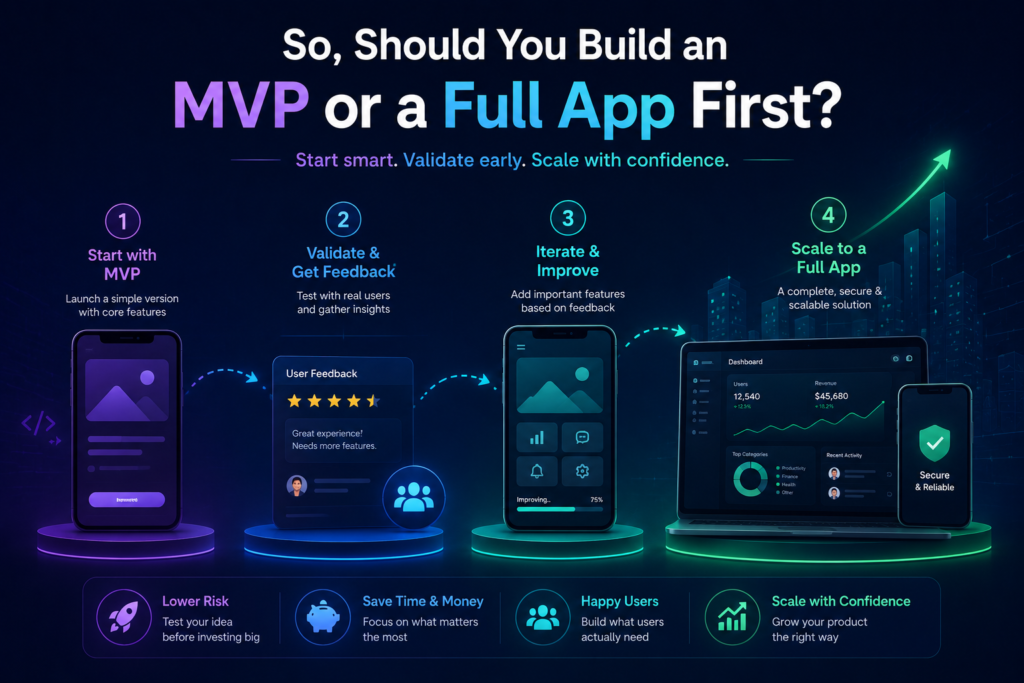
So, Should You Build an MVP or a Full App First?
For most new and unvalidated app ideas, starting with a well-designed MVP is usually the lower-risk approach.
It allows you to:
- Validate real demand
- Launch sooner
- Reduce unnecessary development
- Learn from actual users
- Test monetization
- Prioritize future features based on evidence
But an MVP should not be treated as an automatic rule.
A more complete initial application may be the better choice when core value requires multiple connected systems, requirements are already proven, strict security or compliance standards apply, or the application must immediately support business-critical operations.
The decision should not be based on trends or assumptions such as “every startup needs an MVP.”
It should be based on risk, evidence, users, technical requirements, business goals, and the cost of being wrong.
The best first version is not always the smallest one.
It is the smallest version that can responsibly deliver value, test the right assumptions, and create a foundation for what comes next.
Ultimately, the right MVP vs full app strategy depends on how much you already know about your users, market, and technical requirements.
Frequently Asked Questions
Should I build an MVP or a full app first?
If your app idea, target market, user behavior, or business model is still unvalidated, an MVP is generally the safer starting point. If requirements are already proven or the product needs a comprehensive feature set to deliver meaningful value, a fuller initial application may be appropriate.
How long does it take to build an MVP?
Development time varies significantly based on functionality, platforms, integrations, design, backend complexity, AI features, and security requirements. A focused MVP may take weeks or several months. A realistic timeline should be based on defined scope rather than a generic industry estimate.
Can AI help build an MVP faster and cheaper?
Yes. AI can accelerate prototyping, coding, testing, documentation, and other parts of development. However, AI-generated output still requires appropriate human review, especially for architecture, security, scalability, user experience, and maintainability.
Is an AI-generated prototype the same as a real MVP?
Not necessarily. A prototype may demonstrate an interface or concept without being ready for actual users. A production MVP must reliably deliver core value and may require secure authentication, backend infrastructure, databases, APIs, analytics, testing, monitoring, and privacy controls.
What features should an MVP include?
An MVP should include the smallest set of features necessary to deliver the product’s core value and test its most important assumptions. Features that do not contribute directly to that purpose should usually be considered for later versions.
Can an MVP scale into a full application later?
Yes. A properly planned MVP can evolve into a complete application. The initial architecture should avoid unnecessary overengineering while maintaining reasonable standards for code quality, security, data structure, and future extensibility.
What is the biggest mistake businesses make when building an MVP?
One of the biggest mistakes is focusing on making the product as cheap or small as possible instead of making it useful enough to produce reliable learning. An MVP that is buggy, confusing, insecure, or unable to deliver meaningful value may generate misleading feedback.
Ready to Turn Your App Idea Into the Right First Product?
Choosing between an MVP and a full application is not simply a development decision. It affects your budget, timeline, technical foundation, market validation, and long-term growth.
At 3BTech, we help businesses evaluate their ideas, identify essential features, choose the right technical approach, and build mobile applications designed around real business goals.
Whether you need a focused MVP to validate a new idea or a more comprehensive application ready for complex requirements, the right strategy begins before development starts.
Have an app idea but unsure whether to start with an MVP or a full product? Let’s discuss your requirements and identify the smartest path forward.
CTA Button: