

You finally have an app idea. It solves a real problem, you’ve spent weeks refining it, and you’re excited about turning it into a successful business. Then one question starts bothering almost every founder: can someone steal your app idea? It is one of the most searched questions by entrepreneurs because nobody wants months of planning to be copied by someone else.
The good news is that while protecting your app idea is important, successful startups rarely win because they kept their idea secret. They succeed because they execute better, understand their customers, and continuously improve their products. This guide explains whether can someone steal your app idea is a real risk, how intellectual property works, and the practical steps every founder should take before sharing their concept with developers, agencies, or investors.
Why Every Founder Worries About App Idea Theft
If you have never built a digital product before, worrying about your app idea is completely natural. Every entrepreneur invests time, research, and creativity into developing a concept they believe can become a successful business. As a result, the question can someone steal your app idea often creates hesitation and prevents founders from speaking with developers or validating their products. Unfortunately, waiting too long can be more damaging than sharing your idea with the right people. Successful founders understand that speed, customer feedback, and execution create competitive advantages that are far more valuable than secrecy alone.
If you’re serious about building a successful startup, protecting your idea is only one part of the journey. Before investing in development, it’s important to understand Should You Build an MVP or a Full App First? so you can make the right product decisions from the beginning. You should also learn why Building the Right App is more valuable than simply launching quickly. If you’re still planning your product, Have an App Idea? provides a complete roadmap for first-time founders, while improving your online visibility after launch starts with understanding Website Speed and SEO, helping your business attract more users and grow sustainably.
Can Someone Steal Your App Idea?
The simple answer is yes and no. Someone can hear your concept and decide to build something similar, but that does not mean they have stolen your business. An app idea by itself is rarely protected by law because ideas are considered concepts rather than intellectual property. This is why thousands of businesses can create food delivery apps, fitness apps, or marketplace platforms without breaking any laws. When founders ask can someone steal your app idea, they are usually worried about losing their opportunity. In reality, opportunities are created through execution. The companies that understand their customers, launch faster, improve continuously, and build trust almost always outperform those who simply had the idea first.
What Actually Makes Your App Valuable?
Many first-time founders believe the idea is the most valuable part of the business. In reality, the idea is only the starting point. What creates real value is everything that comes afterward. Your product strategy, user experience, branding, customer support, marketing, technology, and ongoing improvements make your business difficult to copy. Even if someone hears your concept, they still need to understand the market, build the product, attract users, and continue improving it. Instead of repeatedly asking can someone steal your app idea, ask yourself how you can create a product that customers genuinely prefer over every alternative.
Ideas Are Easy, Execution Is Difficult
History proves that similar ideas can exist at the same time while producing completely different results. Many companies enter the same market, but only a few become industry leaders. The difference is rarely the originality of the idea. It is the quality of execution. A founder who validates their app idea, listens to customers, improves the product, and delivers an excellent user experience has a much greater chance of success than someone who spends months hiding an untested concept. This is why experienced entrepreneurs spend less time asking can someone steal your app idea and more time building something customers genuinely need.
Why Most Investors Are Not Interested in Stealing Ideas
Professional investors review hundreds of startup pitches every year. Their business is investing in promising founders, not copying applications. When founders ask can someone steal your app idea before meeting investors, they often misunderstand how venture capital works. Investors evaluate the team, market opportunity, business model, customer demand, and growth potential. They know that an idea without execution has very little commercial value. Instead of worrying about investors stealing your concept, focus on demonstrating why your team is capable of building a successful business.
Before moving forward with your app idea, it’s worth exploring trusted resources to better understand intellectual property, branding, and application security. The United States Copyright Office explains what types of creative work are protected under copyright law, while the United States Patent and Trademark Office (USPTO) provides guidance on trademarks and patents for businesses. Founders planning to launch globally can also learn about international intellectual property standards through the World Intellectual Property Organization (WIPO). In addition, following the security recommendations published by OWASP Application Security helps developers build safer, more reliable applications and reduce common security risks before launch.
Should You Use an NDA Before Sharing Your App Idea?
One of the first questions founders ask after wondering can someone steal your app idea is whether they should ask everyone to sign a Non Disclosure Agreement (NDA). The answer depends on who you are talking to. If you are working with freelancers, software developers, agencies, or technical partners, an NDA is often a smart decision because it clearly explains what information should remain confidential.
However, asking every investor to sign an NDA before a first meeting is uncommon. Professional investors review hundreds of business ideas every year, and most prefer evaluating opportunities without legal restrictions. Instead of relying entirely on paperwork, choose experienced professionals with a strong reputation. Trust, transparency, and a clear contract usually provide better protection than an NDA alone.
Can You Copyright an App Idea?
Many entrepreneurs believe they can copyright an app idea before development begins. Unfortunately, that is not how copyright law works. Copyright protects original work that has already been created, not the concept itself. For example, your application’s source code, interface designs, graphics, written content, and documentation can receive copyright protection because they are original creations.
The idea of creating a fitness app, marketplace, or booking platform cannot be copyrighted because anyone can legally develop a similar concept. This is why founders asking can someone steal your app idea should focus less on protecting the idea itself and more on protecting the assets created during development.
Should You Trademark Your Brand?
While an app idea cannot usually be protected, your brand certainly can. Your business name, application name, company logo, and visual identity all become valuable assets as your startup grows. Registering a trademark helps prevent other businesses from using confusingly similar branding. Many successful companies become recognizable because customers trust their brand, not simply because of the features inside the application. When founders ask can someone steal your app idea, they often overlook the importance of building a memorable brand that customers recognize and trust.
Who Owns the Source Code?
Ownership is one of the most important topics founders should discuss before development begins. If you hire a software company or freelance developer, your agreement should clearly state who owns the source code, database, designs, documentation, APIs, and other project files. Professional development companies usually transfer ownership according to the signed contract once agreed milestones have been completed. Never assume ownership happens automatically. Asking these questions before development protects both you and your development partner while reducing future disputes. Protecting your business is far more valuable than constantly asking can someone steal your app idea after the project has already started.
How to Choose a Development Partner You Can Trust
Choosing the right development partner is one of the best ways to reduce the risk surrounding your app idea. Instead of selecting the cheapest option, evaluate the company’s experience, communication, client reviews, portfolio, and development process. A trustworthy team asks detailed questions about your business goals before discussing technology. They want to understand your users, your competitors, and the problem you are solving. If someone promises to build your entire application without asking meaningful questions, consider it a warning sign. Professional companies value their reputation and long term relationships far more than copying a single project.
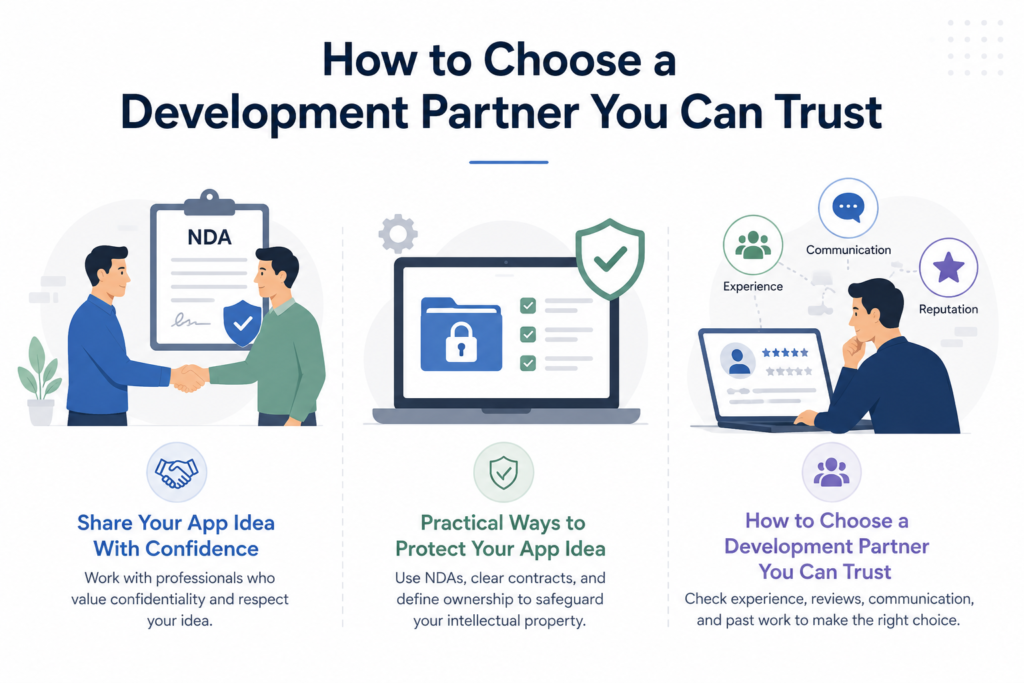
Share Your App Idea With Confidence
Many founders delay progress because they continue asking can someone steal your app idea instead of validating it. While protecting confidential information is important, refusing to speak with customers, developers, or advisors can slow your business down. Share your concept strategically, use written agreements where appropriate, document your work, and choose experienced professionals. The faster you validate your assumptions and begin improving your product, the harder it becomes for competitors to catch up. Successful startups are built through execution, customer feedback, and continuous
Practical Ways to Protect Your App Idea
Protecting your business does not always require expensive legal strategies. In many situations, simple business practices provide stronger protection than complicated paperwork. Start by documenting your app idea, product roadmap, feature list, and business goals from the beginning.
Keep records of meetings, research, and design decisions so you always have a clear history of how your product evolved. When working with developers or agencies, define project milestones, ownership rights, payment terms, and confidentiality requirements before development begins. The more organized your process becomes, the easier it is to protect both your business and your intellectual property.
Common Mistakes First Time Founders Make
Many entrepreneurs spend so much time worrying about can someone steal your app idea that they ignore the things that actually determine success. Some founders refuse to talk to customers because they fear someone will copy them. Others delay development for months while trying to make every feature perfect before launch. Many choose the cheapest developers available without checking their experience or portfolio. Some forget to sign proper agreements, while others skip product validation completely. These mistakes usually create far bigger problems than someone building a similar application. Successful founders understand that learning from real users is far more valuable than keeping every detail secret.
Build Faster Than Competitors Can Copy
One of the best ways to protect your business is simply moving faster. Every month spent hiding your app idea is another month your competitors could spend improving their own products. Instead of chasing perfection, focus on launching a valuable first version, collecting feedback, and improving continuously. Markets change quickly, and businesses that learn faster usually outperform businesses that spend too much time planning. Speed does not mean rushing poor quality products to market.
It means making smart decisions, validating ideas early, and continuously delivering improvements based on customer feedback.
if you’re planning to launch your product internationally, the World Intellectual Property Organization (WIPO) offers valuable information about global intellectual property standards. In addition, following the best practices published by OWASP Application Security can help developers build secure, reliable applications and reduce common security risks before launch.
What Should You Do Before Launch?
Before publishing your application, review every important part of your project. Make sure your app idea has been validated by real users, your branding is complete, your legal agreements are signed, and your source code ownership is clearly defined. Test the application on multiple devices, verify that important features work correctly, and prepare a launch strategy that includes customer support and future updates. A successful launch is not created by luck. It is created through careful preparation and attention to detail.
Building the App Is Easy. Building the Right App Is the Hard Part.
Why AI-Generated Apps Fail: 10 Mistakes to Avoid in 2026
Local SEO for Small Businesses: 10 Proven Strategies to Rank Higher and Get More Customers
Your Biggest Competitive Advantage
Many founders continue asking can someone steal your app idea, but the most successful businesses focus on a different question: How can we create more value than anyone else? Competitors may copy features, layouts, or pricing models, but they cannot easily copy your customer relationships, product knowledge, company culture, or long-term vision. Every update you release, every customer you help, and every improvement you make increases the gap between your business and the competition. The strongest competitive advantage is not secrecy. It is consistent execution.
Launch, Learn, and Keep Improving
Building a successful application is an ongoing journey rather than a one-time project. The companies that dominate their industries rarely stop after launch. They continue listening to customers, improving performance, fixing problems, and adding valuable features over time. Instead of worrying every day about can someone steal your app idea, invest that energy into building a product people genuinely enjoy using. Businesses that continuously improve almost always outperform businesses that simply had a good idea.
Before moving forward with your app idea, it’s worth exploring trusted resources to better understand intellectual property, branding, and application security. The United States Copyright Office explains what types of creative work are protected under copyright law, while the United States Patent and Trademark Office (USPTO) provides guidance on trademarks and patents for businesses.
Frequently Asked Questions
Can someone steal your app idea before you launch?
This is one of the most common concerns among founders. While someone can create a similar product, they cannot legally copy your original source code, branding, designs, or other protected assets. The best protection is validating your app idea, building quickly, and continuously improving your product.
Should I use an NDA before discussing my app idea?
An NDA is useful when discussing confidential information with developers, freelancers, agencies, or business partners. However, professional investors usually do not sign NDAs during initial meetings because they review many startup ideas every year.
Can I protect my app idea with a patent?
In some cases, unique technical inventions or innovative processes may qualify for patent protection, but most general app ideas do not. If your product contains a genuinely innovative technology, consult an intellectual property professional before filing.
What is the safest way to share my app idea?
Share your app idea with trusted professionals, document your work, use written agreements when appropriate, and avoid revealing unnecessary technical details during early discussions. Focus on explaining the problem you’re solving rather than every implementation detail.
Is execution really more important than the idea?
Absolutely. Thousands of successful businesses were not the first to enter their market. They became successful because they executed better, delivered better customer experiences, improved continuously, and built stronger brands.
Final Thoughts
If you’re still asking can someone steal your app idea, remember that every successful entrepreneur has had the same concern at some point. While protecting your business is important, fear should never stop you from validating your concept, talking to potential customers, or working with experienced professionals.
The strongest startups are built on more than an idea. They succeed because founders understand their market, solve real problems, listen to customer feedback, and continue improving after launch. Legal agreements, trademarks, copyrights, and good business practices all play an important role, but they cannot replace strong execution.
Instead of spending months worrying about whether someone can copy your concept, invest that time into refining your app idea, building a valuable product, and creating an experience customers genuinely enjoy. In the long run, your ability to execute, innovate, and earn customer trust will always be your greatest competitive advantage.
Ready to Turn Your App Idea Into Reality?
Whether you’re validating a new concept or preparing to build your first mobile application, the right strategy can help you avoid costly mistakes and launch with confidence.