The Hidden Cost of Legacy Software: Why Businesses Are Modernizing in 2026
Hamza Taj · August 5, 2026 · 10 min read
Legacy Software Modernization enables businesses to replace outdated applications with secure, scalable, and high-performance digital solutions that support long-term growth.
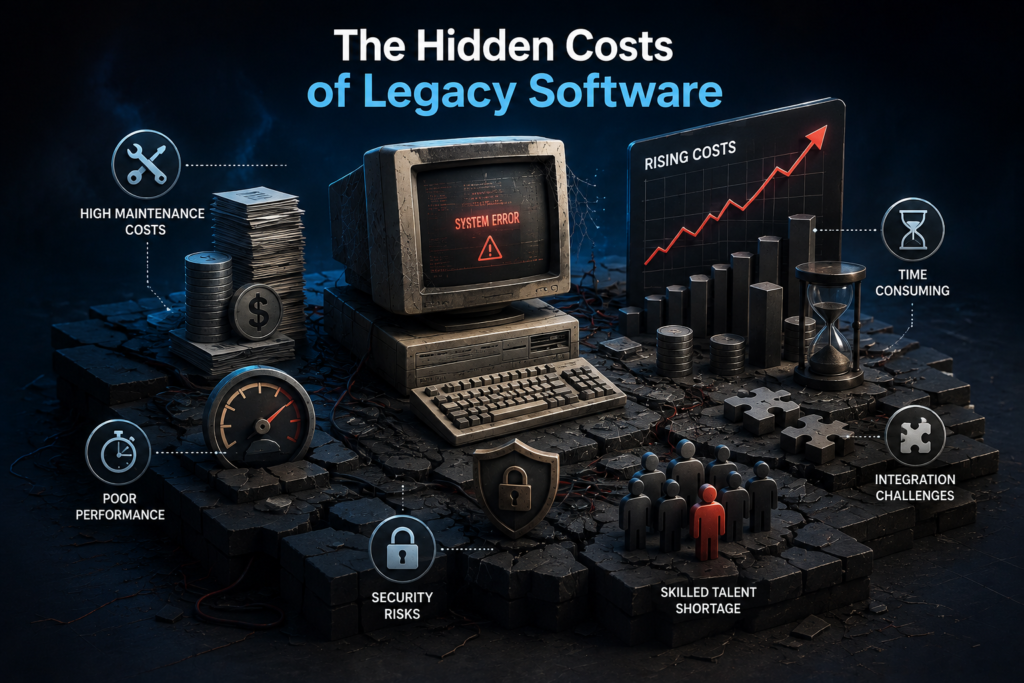
Many businesses still rely on software that was built five, ten, or even twenty years ago. While these legacy systems may continue to function, they often become a silent obstacle to business growth. What once served as a reliable solution can gradually create higher maintenance costs, security risks, poor user experiences, and limited scalability.
In today’s competitive digital landscape, technology evolves rapidly. Customers expect fast, seamless digital experiences, employees need efficient tools to stay productive, and businesses require software that can adapt to changing market demands. Unfortunately, legacy software often struggles to meet these expectations.
As organizations embrace AI, automation, cloud computing, and advanced analytics, outdated systems are becoming increasingly difficult to maintain. Rather than investing more money into temporary fixes, businesses across industries are choosing legacy software modernization as a long-term strategy for sustainable growth.
Whether you’re running a manufacturing company, healthcare organization, financial institution, logistics business, or eCommerce platform, modernizing outdated software has become a strategic investment rather than just an IT upgrade.
In this guide, we’ll explore the hidden costs of legacy software, why modernization has become a priority in 2026, and how businesses can successfully transition to modern, scalable solutions.
Why Legacy Software Is Becoming a Business Risk
Many organizations assume that if their software is still working, there’s no immediate need to replace it. However, functionality alone doesn’t determine whether software continues to support business objectives.Businesses planning long-term digital transformation often invest in Custom Software Development Servicesto build secure and scalable applications.
Legacy applications were designed for a different technological landscape. They often lack compatibility with modern APIs, cloud infrastructure, artificial intelligence tools, and today’s cybersecurity standards. As a result, they gradually become harder and more expensive to maintain.
What begins as a stable business application can eventually slow innovation, increase operational costs, and create unnecessary risks.
Some of the most common challenges include:
Increasing maintenance expenses
Slow application performance
Security vulnerabilities
Limited scalability
Poor customer experience
Difficult system integrations
Dependence on outdated technologies
Higher infrastructure costs
Reduced employee productivity
These issues rarely appear overnight. Instead, they accumulate over time until the software becomes a barrier to growth rather than a tool for enabling it.
The Real Hidden Costs of Legacy Software
Many companies only calculate the direct cost of maintaining their existing software. However, the true financial impact goes far beyond maintenance fees.Investing in Legacy Software Modernization early helps organizations reduce maintenance costs, improve security, and avoid costly operational disruptions.
Rising Maintenance Costs
Older software often requires specialized developers who are familiar with outdated programming languages and frameworks. Finding professionals with these skills becomes increasingly difficult each year, making support more expensive.
Businesses also spend significant time fixing recurring issues instead of investing in innovation.
Lost Productivity
Employees rely on software every day to complete essential business tasks.
When systems are slow, outdated, or disconnected from other business applications, teams waste valuable hours performing manual work that could easily be automated.
Even small inefficiencies repeated across multiple departments can result in thousands of lost working hours annually.
Security Risks
Cybersecurity threats continue to evolve, but many legacy systems no longer receive security patches or vendor support.
Outdated applications often contain vulnerabilities that attackers actively target.
For businesses handling customer information, payment data, or confidential records, a single security breach can result in financial losses, reputational damage, and regulatory penalties.
Poor Customer Experience
Modern customers expect websites and applications to be fast, responsive, and easy to use across all devices.
Legacy software frequently struggles to deliver the seamless digital experiences users now consider standard.
Slow loading times, outdated interfaces, and technical errors can lead to lower customer satisfaction and reduced conversion rates.
Limited Business Growth
One of the biggest hidden costs is lost opportunity.
As businesses expand, they need software capable of supporting new products, larger customer bases, multiple locations, and international operations.
Legacy applications often make expansion more complicated by limiting flexibility and increasing technical debt.
Instead of supporting innovation, outdated systems begin slowing it down.
Why Businesses Are Prioritizing Software Modernization in 2026
Digital transformation is no longer reserved for large enterprises. Businesses of every size are modernizing their technology to remain competitive in increasingly digital markets.Modern organizations increasingly adopt cloud-native technologies to improve scalability and resilience.Google Cloud Application Modernization outlines proven strategies for transforming legacy applications into modern, cloud-ready solutions.
Several key trends are driving this shift.
Artificial Intelligence Integration
Modern businesses are adopting AI-powered solutions to automate repetitive tasks, improve decision-making, and enhance customer experiences.
Legacy systems often cannot integrate with AI tools without significant redevelopment.
Modern software architecture makes AI adoption far simpler and more cost-effective.
Many older applications were never designed for cloud environments.
Modernization enables organizations to fully leverage cloud platforms while improving reliability and scalability.
Increased Cybersecurity Requirements
Regulatory compliance and cybersecurity standards continue to become more demanding.
Organizations are investing in modern software that includes stronger authentication, encryption, monitoring, and compliance capabilities by design.
Faster Business Innovation
Companies introducing new digital products need software that can evolve quickly.
Modern development frameworks allow businesses to launch new features faster while reducing deployment risks through continuous integration and automated testing.
Signs Your Business Has Outgrown Legacy Software
Many organizations continue using outdated systems because replacing them appears expensive or disruptive. However, delaying modernization often results in even higher long-term costs. Recognizing the warning signs early can help businesses plan a smoother transition while maintaining operational continuity.
Some common indicators include:
Software performance is noticeably slower than before.
Employees rely on spreadsheets or manual processes to complete everyday tasks.
Integrating new applications or third-party platforms is difficult or impossible.
Security updates are no longer available from the software vendor.
Maintenance costs continue to rise every year.
Your development team spends more time fixing issues than building new features.
Customers frequently report usability or performance problems.
The system cannot support business expansion or increasing workloads.
Reporting and analytics are limited or outdated.
The software is incompatible with cloud services or AI-powered solutions.
If your business is experiencing several of these challenges, modernization should be viewed as a strategic investment rather than an operational expense.
The Benefits of Modernizing Legacy Software
Modern software does far more than replace outdated technology. It creates a stronger digital foundation that enables businesses to innovate faster, improve customer experiences, and operate more efficiently.
Improved Performance
Businesses that prioritize Legacy Software Modernization are better positioned to innovate, integrate new technologies, and respond quickly to changing market demands. Modern applications are designed for speed, reliability, and scalability. Faster systems improve employee productivity while delivering smoother experiences for customers.
Performance improvements often lead to:
Faster page loading
Reduced downtime
Better system responsiveness
Improved customer satisfaction
Stronger Cybersecurity
Cyber threats continue to become more sophisticated each year. Modern software includes built-in security features that help businesses protect sensitive information and comply with industry regulations.
Security improvements typically include:
Multi-factor authentication
Data encryption
Secure APIs
Continuous monitoring
Regular security updates
Compliance-ready architecture
By reducing vulnerabilities, businesses lower the risk of costly data breaches and operational disruptions.
Lower Long-Term Costs
Although modernization requires an initial investment, it often reduces technology costs over time.
Businesses can significantly lower expenses related to:
Server maintenance
Software licensing
Emergency bug fixes
Infrastructure upgrades
Manual processes
Legacy hardware
Instead of constantly repairing outdated systems, organizations invest in technology that supports long-term growth.
Better Customer Experience
Customer expectations have changed dramatically over the past few years.
Today’s users expect:
Fast websites
Mobile-friendly applications
Personalized experiences
Secure online transactions
Seamless digital interactions
Modern software enables businesses to meet these expectations while improving customer retention and conversion rates.
Easier Integrations
Modern businesses rely on multiple software platforms working together.
Whether integrating with CRM systems, ERP platforms, payment gateways, cloud services, marketing tools, or AI solutions, modern applications provide the flexibility required for seamless connectivity.
This improves operational efficiency while reducing repetitive manual work.
Greater Scalability
Growth should never be limited by technology.
Modern software architectures are designed to scale as businesses expand into new markets, add more users, launch new products, or process larger volumes of data.
Instead of rebuilding systems every few years, businesses can continue evolving their technology with minimal disruption.
Modern Software Modernization Strategies
There is no one-size-fits-all approach to modernization. The right strategy depends on business objectives, technical requirements, existing infrastructure, and available resources.
Rehosting
Often referred to as “lift and shift,” this approach moves existing applications to cloud infrastructure with minimal code changes.
It provides faster deployment while reducing infrastructure costs.
Refactoring
Refactoring involves improving the application’s internal code without significantly changing its functionality.
This approach improves maintainability, performance, and scalability while preparing the software for future enhancements.
Replatforming
Businesses may upgrade selected technologies, databases, or infrastructure while keeping the application’s core functionality intact.
This strategy balances cost with improved performance.
Rebuilding
In some situations, existing software has become too outdated to modernize efficiently.
Rebuilding allows organizations to develop a completely new application using modern technologies while preserving essential business processes.
Although this requires greater investment, it often delivers the highest long-term value.
Cloud-Native Development
Many organizations are choosing cloud-native applications built around microservices, containers, and scalable cloud infrastructure.
Cloud-native development supports:
Faster deployment
Better reliability
Automatic scaling
Improved security
Continuous updates
It also enables businesses to adopt emerging technologies more easily in the future.
Common Mistakes Businesses Should Avoid
Software modernization is a major business initiative. Avoiding common mistakes can significantly improve project success.
Some of the most common pitfalls include:
Treating modernization as an IT project instead of a business strategy.
Delaying upgrades until systems become unstable.
Focusing only on cost rather than long-term value.
Ignoring employee training and change management.
Choosing technology without considering future scalability.
Migrating outdated processes instead of improving them.
Working without a clear modernization roadmap.
Successful projects begin with clear business objectives and a well-defined implementation strategy.
Why Choose 3BTech for Software Modernization?
Modernizing legacy software requires more than technical expertise. It demands a strategic technology partner who understands your business goals, operational challenges, and long-term growth plans.
At3BTech, we help businesses across the UK, USA, Canada, Australia, and beyond transform outdated systems into modern, scalable digital solutions.
Our expertise includes:
Custom Software Development
Legacy Software Modernization
Cloud Migration Services
Enterprise Application Development
API Development & Integrations
Mobile App Development
AI-Powered Software Solutions
Business Process Automation
Software Maintenance & Support
Performance Optimization
Every solution we build is designed with scalability, security, user experience, and future growth in mind, helping businesses stay competitive in an increasingly digital world.
Successful digital transformation often starts with a well-planned modernization strategy. Microsoft Azure Application Modernization provides guidance for upgrading legacy applications while improving security, performance, and long-term scalability.
Frequently Asked Questions
What is legacy software?
Legacy software refers to older applications or systems that continue to perform business functions but rely on outdated technologies, making them difficult to maintain, secure, or scale.
Why should businesses modernize legacy software?
Modernization improves security, performance, scalability, and integration capabilities while reducing maintenance costs and supporting long-term business growth.
Is replacing legacy software always necessary?
Not always. Depending on the condition of the existing application, businesses may choose to rehost, refactor, replatform, or selectively rebuild parts of the system.
How long does software modernization take?
Project timelines vary depending on application complexity, business requirements, and migration strategy. Smaller modernization projects may take several weeks, while enterprise-scale transformations can take several months.
Does software modernization improve cybersecurity?
Yes. Modern applications support stronger authentication, regular security updates, encryption, compliance standards, and proactive monitoring, significantly reducing cybersecurity risks.
Can legacy software integrate with AI and cloud platforms?
Many legacy applications struggle to support modern AI and cloud technologies. Software modernization enables seamless integration with cloud services, automation platforms, and AI-powered business tools.
Final Thoughts
If your organization still relies on outdated systems, Legacy Software Modernization is the key to improving efficiency, strengthening security, and preparing for future business growth. Legacy software may continue running, but that doesn’t mean it’s helping your business succeed. As technology evolves, outdated systems become increasingly expensive to maintain, harder to secure, and less capable of supporting innovation.
Modernizing your software isn’t simply about adopting new technology—it’s about creating a stronger foundation for future growth. Businesses that invest in scalable, secure, and flexible software today are better positioned to improve efficiency, enhance customer experiences, and respond quickly to changing market demands.
In 2026 and beyond, organizations that embrace software modernization will gain a competitive advantage through increased agility, lower operational costs, and the ability to innovate faster than competitors still relying on outdated systems.
Ready to Modernize Your Legacy Software?
If your business is struggling with outdated applications, rising maintenance costs, or limited scalability, 3BTech can help.
We work with businesses across the United Kingdom, United States, Canada, Australia, and other global markets, delivering modern software solutions that improve performance, strengthen security, and support long-term growth.
Our Software Development Services
Custom Software Development
Legacy Software Modernization
Enterprise Software Development
Cloud Migration Services
AI Software Development
Mobile App Development
Web Application Development
API Development & System Integrations
Business Process Automation
Ongoing Software Maintenance & Support
Whether you’re upgrading an existing application or building a new digital platform from the ground up, our experienced team delivers scalable solutions tailored to your business goals.