

A website can have great content, a professional design, and strong SEO but if it takes too long to load, visitors may leave before they even see what you offer.
This is where website speed and SEO become closely connected.
Website performance affects how quickly users can access your content, interact with your pages, and complete important actions such as submitting a form or requesting a quote. A slow website can create friction at every stage of the customer journey.
Google also recommends paying attention to overall page experience and Core Web Vitals, while making it clear that there isn’t one single page-experience signal that determines rankings.
For businesses investing in organic search in 2026, website performance should therefore be treated as part of the overall SEO strategy—not as an afterthought.
What Is Website Speed?
Website speed refers to how quickly a web page loads and becomes usable for visitors.
It isn’t simply about whether the homepage appears quickly. A good-performing website should allow visitors to:
- See the main content quickly
- Interact with the page without frustrating delays
- Navigate between pages smoothly
- Use the website comfortably on mobile devices
- Complete forms and other important actions without unnecessary waiting
Several technical factors influence this experience, including server response time, image sizes, JavaScript, CSS, third-party scripts, caching, hosting infrastructure, and the way a page is built.
How Are Website Speed and SEO Connected?
The relationship between website speed and SEO is more nuanced than simply saying “faster websites always rank higher.”
Google’s systems consider many signals when determining search results. Page experience is one part of the bigger picture, while useful and people-first content remains essential.
However, performance can influence SEO in several practical ways.
Explore Our Services
1. Better User Experience
People expect websites to respond quickly.
If a visitor lands on a page and has to wait for images, scripts, or content to appear, they may simply go back to Google and choose another result.
A faster experience makes it easier for visitors to consume your content and continue exploring your website.
2. Better Mobile Experience
A large portion of web traffic comes from mobile devices, where network conditions and device capabilities can vary significantly.
A website that feels fast on a powerful desktop computer may feel considerably slower on a mobile phone.
That makes mobile performance an important part of modern SEO performance.
3. Better Engagement
Performance can affect what users actually do after landing on your site.
For example:
Google Search → Blog → Service Page → Contact Form
If every step feels slow, there are more opportunities for visitors to abandon the journey.
A well-optimized website removes unnecessary friction.
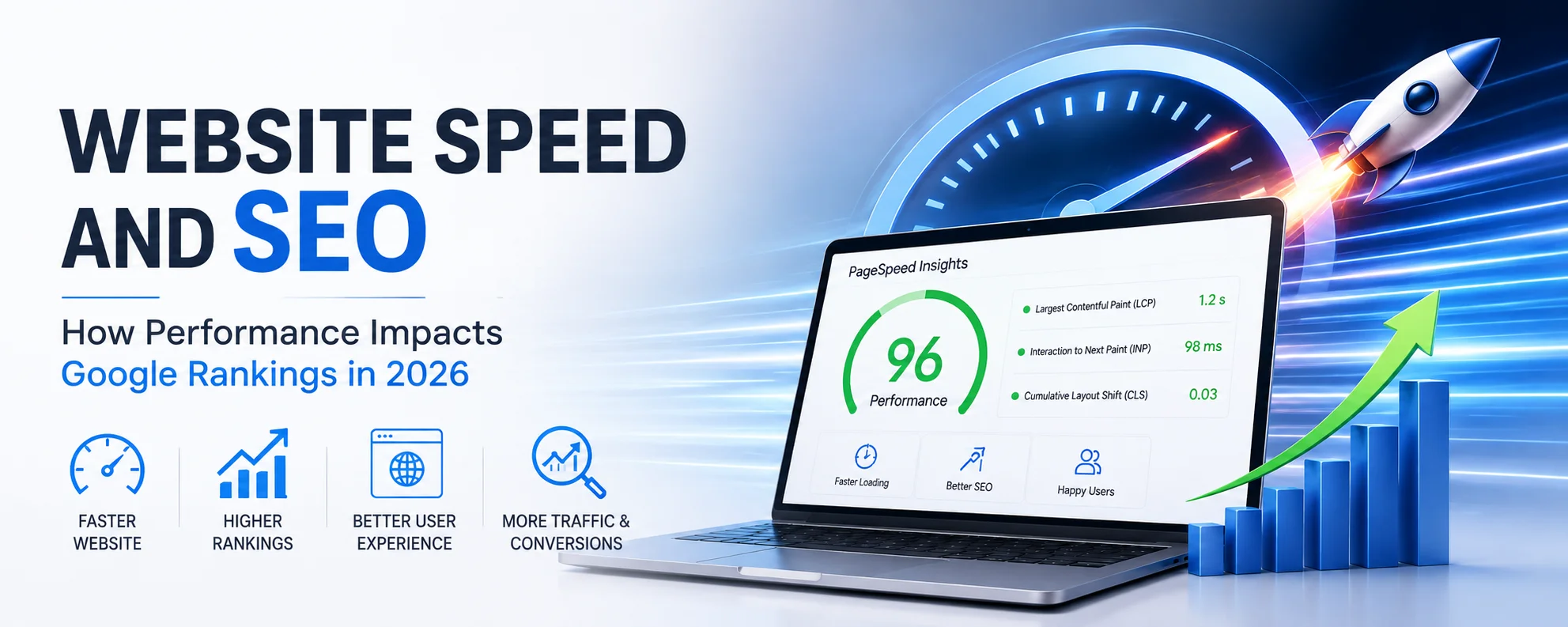
Core Web Vitals and Website Performance
If you’re working on website speed and SEO, you will eventually come across Core Web Vitals.
These metrics help evaluate important aspects of the user experience.
Largest Contentful Paint (LCP)
LCP looks at how quickly the main content of a page becomes visible.
Large images, slow servers, render-blocking resources, and inefficient page structures can all affect this experience.
Interaction to Next Paint (INP)
INP focuses on how responsive a page feels when users interact with it.
For example, when someone clicks a menu, button, filter, or form element, the website should respond smoothly.
Cumulative Layout Shift (CLS)
CLS measures unexpected movement of content while a page loads.
You’ve probably experienced this before: you’re about to click something, an image suddenly loads above it, and the entire page moves.
That’s frustrating for users and good website development should minimize it.
Google recommends achieving good Core Web Vitals as part of providing a strong page experience, while also emphasizing that page experience involves more than Core Web Vitals alone.
What Makes a Website Slow?
There isn’t always one single reason.
Some of the most common causes include:
Large Images
High-resolution images can dramatically increase page weight.
Images should be appropriately sized and compressed before being delivered to users.
Too Much JavaScript
JavaScript can add powerful functionality, but unnecessary scripts can increase loading and interaction costs.
Too Many Third-Party Apps
Chat widgets, tracking tools, review systems, popups, analytics platforms, and marketing scripts can all contribute to page weight.
The goal isn’t to remove everything it is to use only what genuinely contributes to the business.
Poor Hosting
Even a well-built website can struggle when the server is slow or poorly configured.
Hosting infrastructure, server location, caching, and server response time can all influence performance.
Unoptimized Code
Bloated CSS, unnecessary libraries, inefficient queries, and poorly structured code can make websites heavier than they need to be.
How to Improve Website Speed for Better SEO
Improving performance doesn’t necessarily mean rebuilding an entire website.
Start with the biggest bottlenecks.
1. Optimize Images
Use modern image formats where appropriate, resize images according to their actual display dimensions, and avoid loading unnecessarily large assets.
This is especially important for hero sections and product images.
2. Reduce Unnecessary JavaScript
Review scripts and remove functionality that isn’t actually being used.
If a script isn’t helping the user or the business, it deserves to be questioned.
3. Improve Server Response Time
A fast front end cannot completely compensate for a slow server.
Review hosting, caching, database performance, CDN configuration, and server-side code where necessary.
4. Use Browser and Server Caching
Caching allows frequently requested resources to be served more efficiently instead of being generated or downloaded repeatedly.
5. Lazy Load Appropriate Content
Images and other non-critical resources don’t always need to load immediately.
Loading them when they’re actually needed can reduce the initial workload.
6. Minimize Third-Party Scripts
Audit analytics, advertising, chat, social media, review, and other external scripts.
Keep the tools that matter, but don’t allow unnecessary third-party code to slow down the entire website.
Website Speed vs Website Design
A visually impressive website isn’t automatically a high-performing website.
In fact, some design decisions can create performance problems.
Large animations, video backgrounds, oversized images, complex sliders, multiple fonts, and excessive interactive effects can increase the amount of work a browser needs to do.
The goal isn’t to create a boring website.
The goal is to create a website that looks premium and still feels fast.
That balance is especially important for businesses where the website is responsible for generating leads.
Does a Fast Website Guarantee Higher Google Rankings?
No.
This is an important distinction.
Improving website speed alone doesn’t guarantee that a page will move from position 40 to position 1.
Google considers many factors, including relevance, content quality, links, search intent, technical accessibility, and overall page experience.
Google explicitly recommends creating helpful, reliable, people-first content rather than producing content primarily to manipulate rankings.
So think about performance as one part of a larger SEO system.
Good content + strong relevance + technical SEO + good performance + good user experience
is a much stronger strategy than focusing on speed alone.
How to Check Your Website Speed
There are several ways to evaluate website performance.
Google PageSpeed Insights
Use PageSpeed Insights to identify performance opportunities and understand how your pages perform across different conditions.
Google Search Console
Search Console can help you monitor search performance and identify how your pages are appearing in Google Search.
Chrome DevTools
Developers can use Chrome DevTools to investigate network requests, JavaScript execution, rendering, and other performance bottlenecks.
The important thing is not to obsess over achieving a perfect score.
Instead, identify the problems that have the biggest impact on real users and fix them first.
Why Website Speed Matters for Lead Generation
For a business website, speed isn’t only an SEO concern.
It can directly affect conversions.
Imagine a potential customer searches for:
They click your website.
The page takes several seconds to become usable.
They leave.
You didn’t just lose a pageview you potentially lost a sales opportunity.
This is why businesses should look at website performance and SEO together with conversion optimization.
A fast website should make it easier for visitors to:
- Understand your services
- Explore your portfolio
- Read case studies
- Contact your team
- Request a consultation
- Start a conversation
Website Speed and SEO for Businesses in 2026
As websites become more feature-rich, performance becomes increasingly important.
Modern websites often include:
- AI-powered features
- Analytics
- Personalization
- Chat systems
- Ecommerce functionality
- CRM integrations
- Payment systems
- Marketing automation
- Video
- Interactive elements
All of these can add value but they can also add complexity.
The solution isn’t to avoid modern functionality.
It’s to build and optimize websites so that functionality and performance work together.
Final Thoughts
Website speed and SEO should not be treated as two completely separate disciplines.
A fast website creates a better environment for users to discover your content, explore your services, and take action.
At the same time, performance should never replace good content or sound SEO fundamentals.
The best approach is holistic:
Create useful content → build a technically sound website → optimize performance → improve user experience → measure the results.
If your website is receiving impressions in Google but struggling to turn them into clicks, leads, or customers, performance is one of the areas worth investigating alongside your content and SEO strategy.
Need Help Improving Your Website Performance?
At 3BTech, we build and optimize websites with a focus on performance, scalability, and real business outcomes from custom software and web development to modern digital solutions.
Ready to build a faster website?
How to Choose the Right Software Development Company in 2026