

Launching and growing a business in today’s digital world is more challenging than ever. UK businesses are under constant pressure to improve customer experiences, streamline operations, reduce costs, and stay ahead of competitors. Technology has become the backbone of modern business, but simply using software is no longer enough. Companies now need software that fits their unique processes, supports future growth, and helps them respond quickly to changing market demands.
For many years, off-the-shelf software was the default choice for businesses of all sizes. It offered an affordable way to manage accounting, customer relationships, inventory, project management, and many other day-to-day operations. These ready-made solutions helped thousands of businesses begin their digital transformation without requiring a significant upfront investment.
However, as businesses expand, their needs become more complex. What once seemed like the perfect solution often becomes a barrier to growth. Companies start relying on multiple software platforms that don’t communicate with each other, employees spend valuable time completing manual tasks, and business owners struggle to access the real-time insights they need to make informed decisions. Instead of helping businesses move faster, outdated software can slow down productivity and increase operational costs.
This is one of the main reasons why businesses across the United Kingdom are moving away from generic software and investing in custom software development. Rather than adapting their operations to fit the limitations of ready-made applications, companies are choosing software built specifically around their goals, workflows, and long-term vision.
Whether you’re running a startup, an established company, or a growing enterprise, investing in the right technology has become a strategic business decision rather than just an IT expense. Custom software allows businesses to automate repetitive work, improve collaboration, integrate existing systems, strengthen security, and deliver better customer experiences while remaining flexible enough to grow alongside the business.
If you’re currently relying on off-the-shelf software and wondering whether it’s still the right solution, this guide will help you understand why so many UK businesses are making the switch. We’ll explore the limitations of ready-made software, the advantages of custom software development, the hidden costs many companies overlook, and how choosing the right technology partner can help future-proof your business for years to come.
What Is Off-the-Shelf Software?
Off-the-shelf software, sometimes called ready-made software, is a product developed for a broad market rather than for a specific business. These applications are designed to solve common business problems and are sold to thousands of companies with the same core features. Popular examples include accounting software, CRM platforms, project management tools, inventory management systems, and marketing automation platforms.
The biggest advantage of off-the-shelf software is convenience. Businesses can purchase a subscription, create an account, and begin using the platform almost immediately. For startups and smaller organisations with straightforward requirements, this can be an effective way to digitise operations without investing heavily in custom development.
However, every business works differently. As companies grow, their processes become more specialised, teams expand, customer expectations increase, and existing systems need to work together seamlessly. At this stage, businesses often discover that ready-made software cannot support the way they actually operate. Instead of the software adapting to the business, the business is forced to adapt to the software.
This usually leads to disconnected workflows, additional software subscriptions, manual data entry, and unnecessary complexity. What initially appeared to be an affordable solution gradually becomes more expensive, less efficient, and increasingly difficult to manage.
For this reason, many UK businesses eventually decide to replace off-the-shelf software with custom-built solutions that provide greater flexibility, stronger security, and the ability to scale without limitations.
Why UK Businesses Are Rethinking Their Software Strategy
Technology has evolved rapidly over the last few years, and customer expectations have evolved just as quickly. Businesses are no longer competing solely on price or product quality. Today, success depends on delivering exceptional digital experiences, automating business processes, improving operational efficiency, and making faster, data-driven decisions.
Many companies that invested in ready-made software several years ago are now discovering that their existing systems can no longer keep pace with modern business requirements. Teams often find themselves switching between multiple platforms to complete simple tasks, while managers struggle to access accurate reports because information is scattered across different applications.
As businesses continue to grow, these inefficiencies become more noticeable. Employees spend valuable hours performing manual work that could easily be automated, customer service teams face delays caused by disconnected systems, and business owners pay monthly subscription fees for software that only partially meets their requirements.
Rather than continuing to build temporary solutions around these limitations, businesses across the UK are investing in custom software development that supports their exact workflows and long-term objectives. Instead of relying on generic features designed for thousands of companies, they gain software tailored specifically to the way they operate.
This shift is not simply about replacing one system with another. It is about building technology that helps businesses become more efficient, more profitable, and better prepared for future growth in an increasingly competitive marketplace.
Why Off-the-Shelf Software No Longer Meets Modern Business Needs
When off-the-shelf software first became popular, it solved many common business challenges. Companies could purchase a subscription, set up their accounts, and start managing daily operations without spending months developing their own system. For many businesses, it was the quickest and most affordable way to begin their digital transformation.
However, business requirements rarely stay the same. As companies grow, they introduce new products, expand their teams, open new locations, and serve customers across different regions. Their technology needs naturally become more advanced, but unfortunately, most ready-made software platforms don’t evolve at the same pace.
One of the biggest challenges businesses face is limited flexibility. Off-the-shelf software is designed to work for thousands of organisations, which means it cannot fully support the unique processes that make your business different. Instead of adapting the software to fit your workflow, your team often has to change the way they work just to fit the software’s limitations.
This creates unnecessary delays, duplicate work, and frustration for employees who rely on technology every day. Rather than improving productivity, businesses end up creating manual workarounds that consume valuable time and resources.
Another common issue is integration. Modern businesses rely on multiple digital platforms to manage different areas of their operations. Customer relationship management systems, accounting software, inventory management, payment gateways, marketing platforms, and customer support tools all need to communicate with one another. Unfortunately, many ready-made applications struggle to integrate effectively, forcing employees to manually transfer information between systems.
As a result, businesses lose efficiency, increase the risk of human error, and spend more time managing software than serving customers.
Scalability is another major concern. A software platform that works perfectly for a small business may struggle to support an organisation that has grown significantly over the years. As more employees, customers, and business processes are added, companies often discover they need additional subscriptions, premium upgrades, or expensive third-party plugins just to maintain performance.
Instead of investing more money into software that still doesn’t fully meet their requirements, many UK businesses are choosing to invest in custom software development that grows alongside their organisation.
The Hidden Costs of Off-the-Shelf Software
At first glance, ready-made software appears to be the more affordable option. Monthly subscription plans are usually inexpensive, making them attractive for startups and small businesses. However, the true cost often becomes clear over time.
Many organisations pay for multiple software subscriptions every month because no single platform can manage every aspect of their business. They might use one application for customer management, another for accounting, another for inventory, and several more for communication, reporting, and marketing automation. Individually these subscriptions seem manageable, but together they can cost thousands of pounds every year.
Beyond subscription fees, businesses also pay through lost productivity. Employees spend countless hours switching between systems, entering the same information multiple times, fixing errors, and creating manual reports. These hidden operational costs often exceed the price of investing in a tailored solution.
Another overlooked expense is limited functionality. Businesses frequently purchase premium plans or additional plugins simply to access features they require. Even after paying for upgrades, the software may still fail to support specific workflows or integrate properly with existing systems.
Security and compliance can also become expensive challenges. Many industries require strict control over customer data, user permissions, and regulatory compliance. Generic software offers standard security measures, but businesses often need more advanced protection based on their industry and operational requirements.
When these hidden costs are added together, many organisations realise that continuing to rely on off-the-shelf software is actually more expensive than investing in a long-term custom solution.
Many modern businesses also choose cloud-based infrastructure because it offers better reliability, scalability, and performance. Platforms such as Amazon Web Services (AWS) enable businesses to build secure applications that can grow alongside their operations without major infrastructure changes.
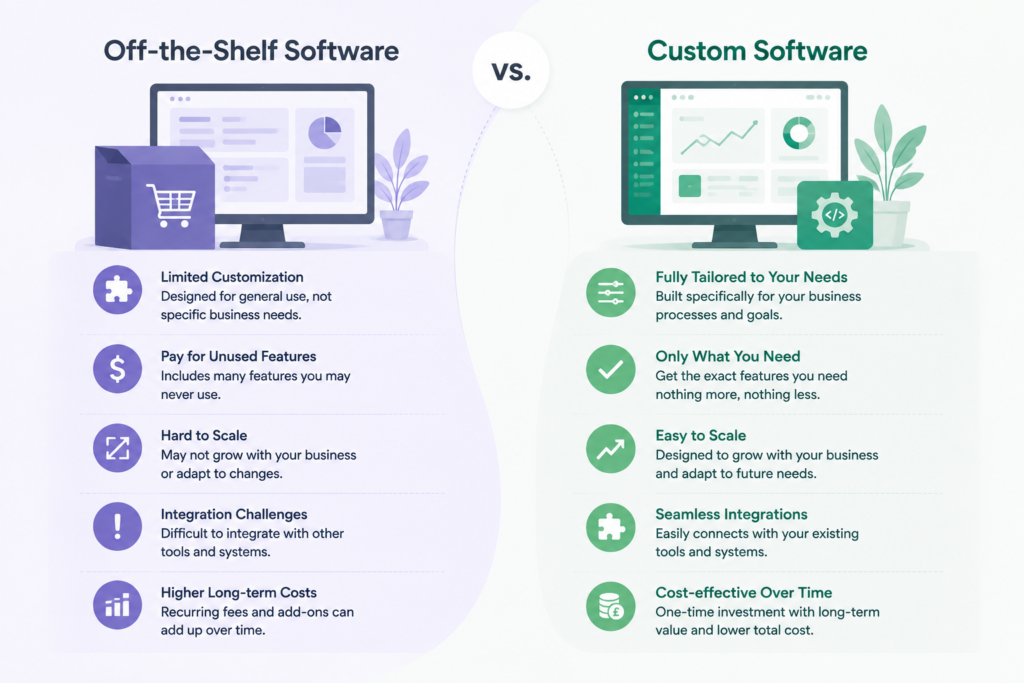
Custom Software vs Off-the-Shelf Software
Choosing between ready-made software and a custom-built solution isn’t simply about today’s budget—it’s about your business’s future.
| Feature | Off-the-Shelf Software | Custom Software |
|---|---|---|
| Built For | General Business Use | Your Business Only |
| Customisation | Limited | Unlimited |
| Scalability | Moderate | High |
| Integrations | Limited | Fully Integrated |
| Ownership | Software Provider | Your Business |
| Security | Standard | Custom Security |
| Monthly Fees | Ongoing Subscription | Minimal Long-Term Costs |
| Flexibility | Restricted | Complete Control |
Businesses that plan for long-term growth often find that custom software development provides greater value, improved efficiency, and a much stronger return on investment.
Rather than paying for features you never use, your business receives software designed around your exact workflows, objectives, and future plans. This not only improves productivity but also creates a better experience for employees and customers alike.
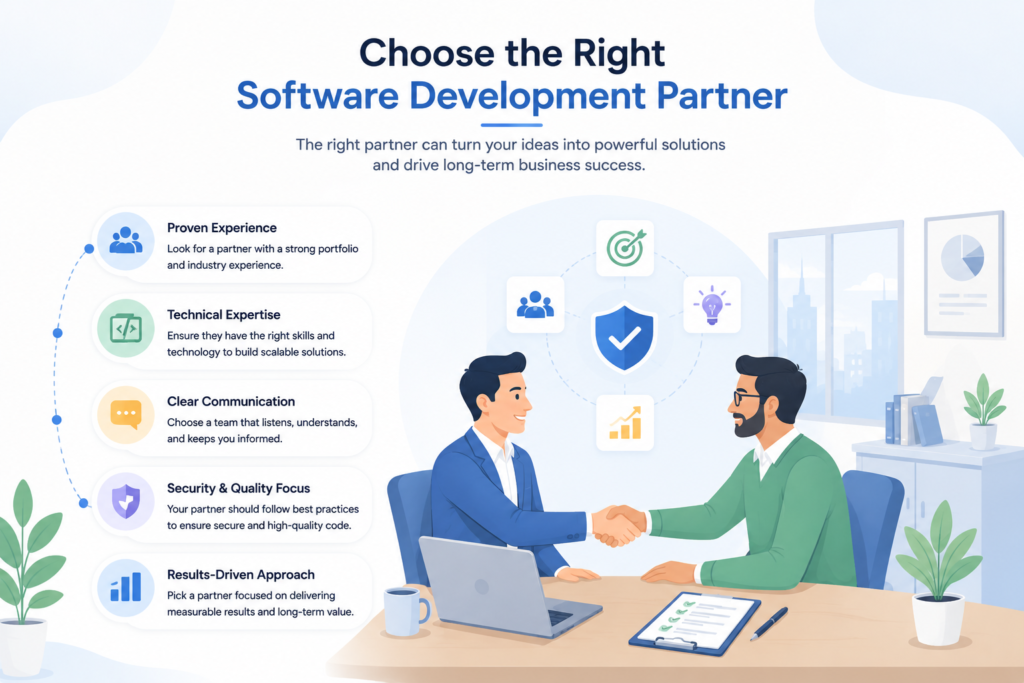
How to Choose the Right Software Development Partner
Choosing the right software development company is just as important as choosing the right technology. Even the best software idea can fail if it’s built by a team that doesn’t understand your business goals, industry challenges, or future plans.
A reliable development partner will spend time understanding how your business operates before recommending a solution. Instead of offering a one-size-fits-all approach, they should create software that improves efficiency, automates repetitive tasks, and supports your long-term growth.
When evaluating a software development company, look for experience in projects similar to yours, a strong portfolio, transparent communication, and a proven development process. The right partner should also provide ongoing support after launch, ensuring your software continues to evolve as your business grows.
It’s also worth considering whether the company offers a complete range of digital services. Businesses often need more than software development alone. Services such as Web Development, Mobile App Development, UI/UX Design, SEO, and Digital Marketing can help maximise the value of your investment by creating a complete digital ecosystem around your business.
Modern business software should also support website performance and search visibility. Following best practices recommended by Google Search Central helps businesses build faster, user-friendly digital experiences that benefit both customers and search engines.
Why Businesses Choose 3BTech
At 3BTech, we understand that every business has different goals, processes, and challenges. That’s why we don’t believe in one-size-fits-all solutions. Our team works closely with businesses to design and develop software that solves real problems while supporting long-term growth.
From startups building their first digital product to established enterprises replacing outdated systems, we create secure, scalable, and high-performance solutions that are tailored to each client’s unique requirements.
Our expertise includes:
- Custom Software Development
- Web Development
- Mobile App Development
- Shopify Development
- WordPress Development
- eCommerce Development
- AI Software Solutions
- SEO & Digital Marketing
Every project is built with performance, security, scalability, and future growth in mind. Whether you’re looking to automate business operations, improve customer experiences, or develop an entirely new software platform, our experienced team is ready to help.
As businesses continue their digital transformation, security and compliance are becoming just as important as performance and scalability. Companies handling customer data should ensure their software follows UK GDPR guidelines to protect sensitive information and maintain customer trust. Investing in secure custom software development not only improves business operations but also helps organisations meet industry standards while preparing for future growth.
Frequently Asked Questions
What is off-the-shelf software?
Off-the-shelf software is a ready-made solution designed for general business use. It includes standard features that work for many businesses but often lacks the flexibility needed to support unique workflows or specialised requirements.
Why are UK businesses moving to custom software?
Many UK businesses are choosing custom software because it provides greater flexibility, improved security, better integrations, and the ability to scale as the business grows. It also reduces reliance on multiple software subscriptions and manual processes.
Is custom software suitable for small businesses?
Absolutely. Custom software isn’t just for large enterprises. Many startups and small businesses invest in tailored solutions to automate operations, improve productivity, and create a stronger foundation for future growth.
How long does custom software development take?
The timeline depends on the complexity of the project. A simple business application may take several weeks, while larger enterprise solutions with advanced features and integrations can take several month
Can custom software integrate with my existing systems?
Yes. Custom software can be integrated with CRM platforms, ERP systems, accounting software, payment gateways, inventory management systems, and many other business tools to create a seamless workflow.
How do I know if my business has outgrown off-the-shelf software?
If your team relies on multiple disconnected applications, spends time performing manual tasks, struggles with limited functionality, or finds it difficult to scale operations, it’s a strong sign that your business could benefit from a custom software solution.
Final Thoughts
Off-the-shelf software has helped countless businesses begin their digital journey, but today’s competitive market demands more flexibility, better performance, and technology that grows alongside your business. As customer expectations continue to rise and digital transformation accelerates, businesses need solutions that are built around their own goals rather than adapting to the limitations of generic software.
Investing in custom software development gives your business complete control over its technology, improves efficiency, strengthens security, and creates opportunities for long-term growth. Instead of managing multiple disconnected platforms, you can streamline operations with software designed specifically for the way your business works.
If you’re ready to replace outdated systems, automate your business processes, or build a powerful digital solution from the ground up, our team is here to help. Request a Free Project Quote
At 3BTech, we help businesses across the UK, USA, Canada, and Australia build secure, scalable, and future-ready software solutions that deliver real business results. Whether you need Custom Software Development, Mobile App Development, Web Development, or a complete digital transformation strategy, we’re ready to help turn your vision into reality.
Looking for a Shopify Development Agency in the UK? Here’s What to Look For in 2026
The Complete Guide to Mobile App Development in 2026: Cost, Process & Best Practices
10 Real AI Workflow Automation Examples That Save Businesses Hours Every Week