

Artificial intelligence is no longer limited to large enterprises with massive budgets. Today, businesses of every size are using AI workflow automation to streamline repetitive tasks, reduce operational costs, and allow teams to focus on more meaningful work. From handling customer inquiries to generating reports, AI is transforming how modern companies operate.
Understanding real AI workflow automation examples helps businesses identify opportunities where automation can replace repetitive manual processes without sacrificing quality. Whether you own a startup, an eCommerce store, or a service-based company, AI-powered workflows can significantly improve productivity and customer experience.These AI workflow automation examples demonstrate how businesses can automate repetitive processes while improving productivity and operational efficiency.
In this guide, we’ll explore ten practical examples of AI workflow automation that businesses are already using to save hours every week and gain a competitive advantage.
What Is AI Workflow Automation?
AI workflow automation combines artificial intelligence with traditional automation to execute business processes intelligently. Unlike basic automation that follows predefined rules, AI can analyze data, recognize patterns, make decisions, and continuously improve its performance.
For example, instead of manually assigning customer support tickets, AI can analyze the customer’s message, determine its urgency, categorize the issue, and automatically send it to the right department.
Businesses using AI workflow automation experience:
-
- Faster operations
-
- Reduced manual work
-
- Higher accuracy
-
- Better customer satisfaction
-
- Improved employee productivity
As AI technology continues to evolve, workflow automation is becoming an essential part of digital transformation strategies across industries.
Why Businesses Are Investing in AI Workflow Automation
Companies spend countless hours performing repetitive administrative tasks that add little value to their growth. AI automation eliminates these repetitive activities while maintaining consistency and improving efficiency.
Some of the biggest benefits include:
-
- Reduced operational costs
-
- Increased employee productivity
-
- Faster response times
-
- Better decision making through AI insights
-
- Fewer human errors
-
- Scalable business processes
These advantages explain why organizations across industries are rapidly adopting AI-powered workflow automation solutions.
Turning Ideas into Real Business Results
Successful businesses don’t adopt new technologies simply because they’re trending—they invest in solutions that solve real operational challenges. Whether it’s reducing manual data entry, improving customer communication, or speeding up internal approvals, intelligent systems help organizations achieve measurable improvements across daily operations. Starting with small, practical implementations allows companies to build confidence, demonstrate value, and expand digital initiatives without disrupting existing workflows.
10 Real AI Workflow Automation Examples
1. AI Customer Support Automation
Customer support teams often receive hundreds of repetitive questions every day. AI chatbots and virtual assistants can instantly answer common questions regarding pricing, shipping, appointments, refunds, and account information.
Instead of waiting for a human representative, customers receive immediate assistance 24/7.
Best Use Cases
-
- Live chat
-
- FAQ automation
-
- Order tracking
-
- Appointment booking
-
- Technical support
Benefits
-
- Faster responses
-
- Lower support costs
-
- Improved customer satisfaction
-
- Reduced workload for support agents
2. Automated Lead Qualification
Sales teams waste valuable time contacting leads that aren’t ready to buy. AI analyzes customer behavior, website interactions, email engagement, and demographic information to identify high quality prospects automatically.
Qualified leads are then assigned directly to the appropriate sales representative.
Best Use Cases
-
- CRM automation
-
- Lead scoring
-
- Sales pipelines
-
- Marketing campaigns
Benefits
-
- Higher conversion rates
-
- Faster sales cycles
-
- Better use of sales resources
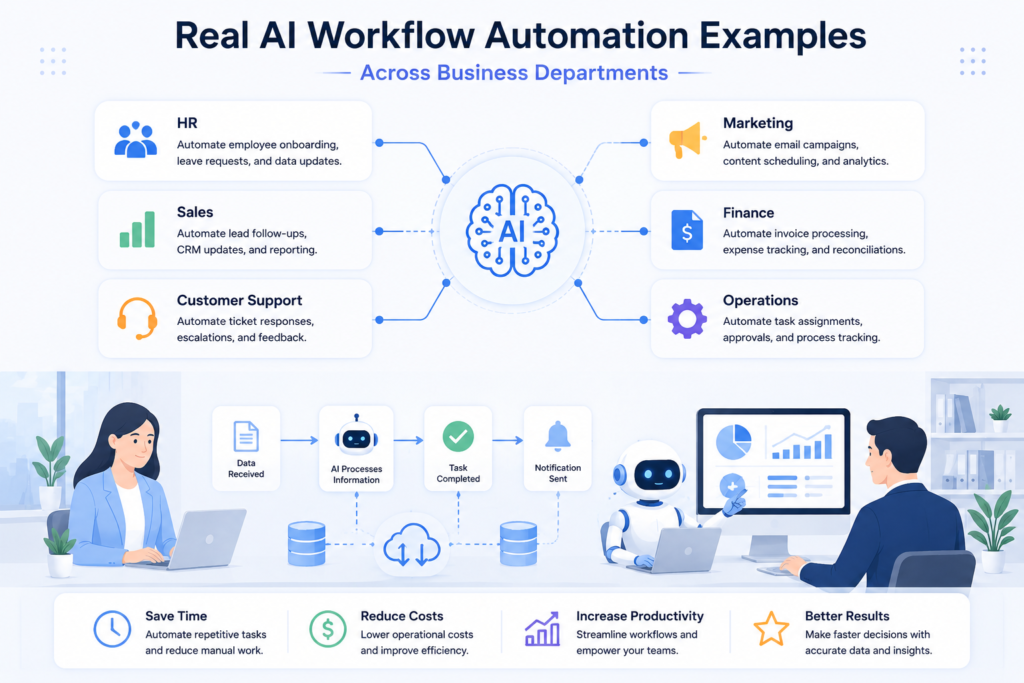
3. Intelligent Email Management
Businesses receive hundreds of emails every week. AI can automatically categorize emails, prioritize urgent messages, generate suggested replies, and even schedule follow-up reminders.
This reduces inbox clutter while improving communication efficiency.
Best Use Cases
-
- Customer inquiries
-
- Internal communication
-
- Sales follow-ups
-
- Appointment confirmations
Benefits
-
- Time savings
-
- Better organization
-
- Faster communication
4. Invoice Processing and Accounting
Manual invoice processing is slow and prone to human error. AI powered accounting systems automatically extract invoice information, validate data, match purchase orders, and update accounting software.
Best Use Cases
-
- Invoice approvals
-
- Expense management
-
- Financial reporting
-
- Payment reminders
Benefits
-
- Fewer accounting errors
-
- Faster processing
-
- Improved financial accuracy
5. HR Recruitment and Employee Onboarding
Hiring new employees involves reviewing resumes, scheduling interviews, sending documents, and collecting employee information.
AI automates much of this process by screening resumes, ranking candidates, scheduling interviews, and guiding new employees through onboarding.
Benefits
-
- Faster recruitment
-
- Improved candidate experience
-
- Reduced HR workload
6. AI Marketing Automation
Marketing teams use AI to schedule campaigns, personalize emails, generate content suggestions, optimize advertisements, and analyze campaign performance.
Instead of manually managing every campaign, marketers receive intelligent recommendations that improve results.
Benefits
-
- Better personalization
-
- Higher engagement
-
- Increased ROI
7. Inventory Management
Retailers and eCommerce businesses use AI to predict inventory demand, monitor stock levels, and automate purchase orders before products run out.
This reduces overstocking while preventing inventory shortages.
Benefits
-
- Better forecasting
-
- Lower storage costs
-
- Improved customer satisfaction
8. Document Processing
Businesses manage contracts, invoices, forms, and reports every day.
AI automatically extracts information from documents, classifies files, identifies missing information, and stores everything securely.
Benefits
-
- Faster document handling
-
- Improved compliance
-
- Reduced manual data entry
9. Automated Report Generation
Managers spend hours preparing weekly and monthly reports.
AI gathers information from multiple systems, creates dashboards, summarizes trends, and generates reports automatically.
Benefits
-
- Real-time insights
-
- Better business decisions
-
- Significant time savings
10. Appointment Scheduling
Businesses that rely on consultations, meetings, or service appointments can automate scheduling using AI assistants.
AI checks availability, sends reminders, reschedules appointments when necessary, and updates calendars without human involvement.
Benefits
-
- Fewer missed appointments
-
- Better customer experience
-
- Less administrative work
Best Practices for AI Workflow Automation
Successful automation begins with identifying repetitive processes that consume significant time. Businesses should automate one workflow at a time, measure its impact, and gradually expand automation across departments.
It’s equally important to train employees on new workflows, monitor AI performance regularly, and keep systems updated to ensure long-term efficiency.
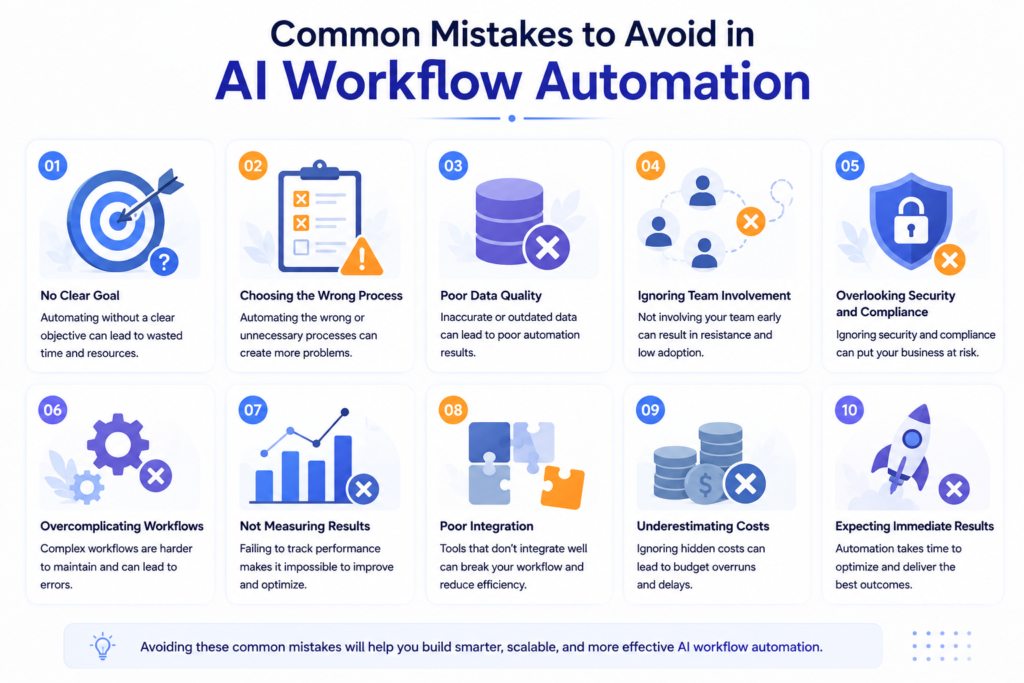
Common Mistakes to Avoid
Many businesses attempt to automate every process at once, leading to confusion and poor implementation. Others overlook employee training or fail to integrate AI with existing software.
Avoid these common mistakes:
-
- Automating inefficient processes
-
- Ignoring data quality
-
- Choosing tools without scalability
-
- Lack of performance monitoring
-
- No clear automation goals
The Future of AI Workflow Automation
AI workflow automation examples include customer support automation, invoice processing, email management, HR onboarding, inventory management, and report generation.
AI workflow automation is becoming smarter every year. Future systems will not only automate repetitive work but also predict customer behavior, optimize business decisions, and collaborate with employees in real time.
Businesses that invest in AI today will be better positioned to improve productivity, reduce costs, and stay competitive in an increasingly digital marketplace.
How AI Is Transforming Everyday Business Operations
Modern businesses are under constant pressure to deliver faster services, reduce operating costs, and improve customer experiences. Artificial intelligence is making this possible by streamlining routine operations that once required significant manual effort. From processing customer requests to organizing internal data, intelligent automation enables teams to complete tasks more efficiently while maintaining accuracy and consistency. As technology continues to evolve, companies that embrace automation are better positioned to adapt to changing market demands and scale their operations with confidence.
Why Businesses Should Embrace Intelligent Automation
Implementing automation is no longer just about saving time it’s about creating smarter, more agile organizations. Companies that integrate AI into their daily workflows can improve collaboration, make faster decisions using real-time insights, and minimize repetitive administrative work. This allows employees to focus on strategic initiatives, innovation, and customer relationships rather than routine tasks. Investing in intelligent automation today helps businesses build a stronger foundation for long-term growth and competitiveness.
How Businesses Can Benefit from AI Workflow Automation Examples
Real-world AI workflow automation examples help businesses understand how artificial intelligence can solve everyday operational challenges. Instead of relying on theory, organizations can learn from practical implementations that improve efficiency, reduce manual work, and streamline business processes. By studying successful examples, companies can identify automation opportunities that align with their goals and deliver measurable results.
Choosing the Right AI Workflow Automation Strategy
Every business has unique workflows, which is why there is no one size fits all approach. Reviewing different AI workflow automation examples allows decision makers to compare solutions, evaluate potential outcomes, and select strategies that best fit their industry. Starting with small automation projects often leads to faster adoption and long-term operational improvements.
Learn from Trusted AI Industry Leaders
To better understand how artificial intelligence is transforming modern businesses, explore trusted resources from industry leaders such as OpenAI, Microsoft AI, Google Cloud AI, IBM Watson, and NVIDIA AI. These platforms regularly publish research, best practices, and real-world innovations that help organizations make informed decisions when adopting intelligent technologies and automation solutions.
Top 10 AI Workflow Automation Tools for Small Businesses in 2026
AI Workflow Automation for Small Businesses: The Ultimate Guide to Save Time and Reduce Costs
The Complete Guide to Mobile App Development in 2026: Cost, Process & Best Practices
Frequently Asked Questions
What is AI workflow automation?
AI workflow automation uses artificial intelligence to automate repetitive business tasks while making intelligent decisions based on data.
Which businesses benefit the most?
Small businesses, eCommerce stores, healthcare providers, financial firms, marketing agencies, and service companies can all benefit from AI workflow automation.
Is AI workflow automation expensive?
Many modern AI automation platforms offer affordable pricing plans, making them accessible to businesses of all sizes.
Can AI replace employees?
AI is designed to automate repetitive tasks, allowing employees to focus on higher value work rather than replacing them entirely.
As more organizations adopt intelligent technologies, learning from proven AI workflow automation examples becomes increasingly valuable. Businesses that implement the right automation strategies today will be better equipped to improve efficiency, support future growth, and remain competitive in an evolving digital landscape.
What are AI workflow automation examples?
AI workflow automation examples include customer support automation, invoice processing, email management, HR onboarding, inventory management, and report generation.
Building a Smarter Business with AI Automation
Businesses that learn from real AI workflow automation examples can identify opportunities to eliminate repetitive work, improve operational efficiency, and deliver better customer experiences. Whether you’re starting with customer support, marketing, or internal operations, adopting proven automation strategies helps create scalable processes that support long-term business growth.
Conclusion
These AI workflow automation examples demonstrate how businesses can eliminate repetitive work, improve efficiency, and deliver better customer experiences. Whether you’re automating customer support, managing inventory, or streamlining recruitment, AI provides practical solutions that save valuable time every week.
As AI technology continues to evolve, businesses that embrace workflow automation today will gain a competitive advantage, improve operational efficiency, and create more scalable processes for future growth.
Ready to automate your business with AI? Our team specializes in AI-powered solutions, workflow automation, and custom software development tailored to your business needs. Contact us today to discover how AI can transform your operations and accelerate growth.By implementing the right AI workflow automation examples, organizations can streamline operations, reduce costs, and prepare for long-term growth.